Thursday, January 10, 2013

The Moon (part III)

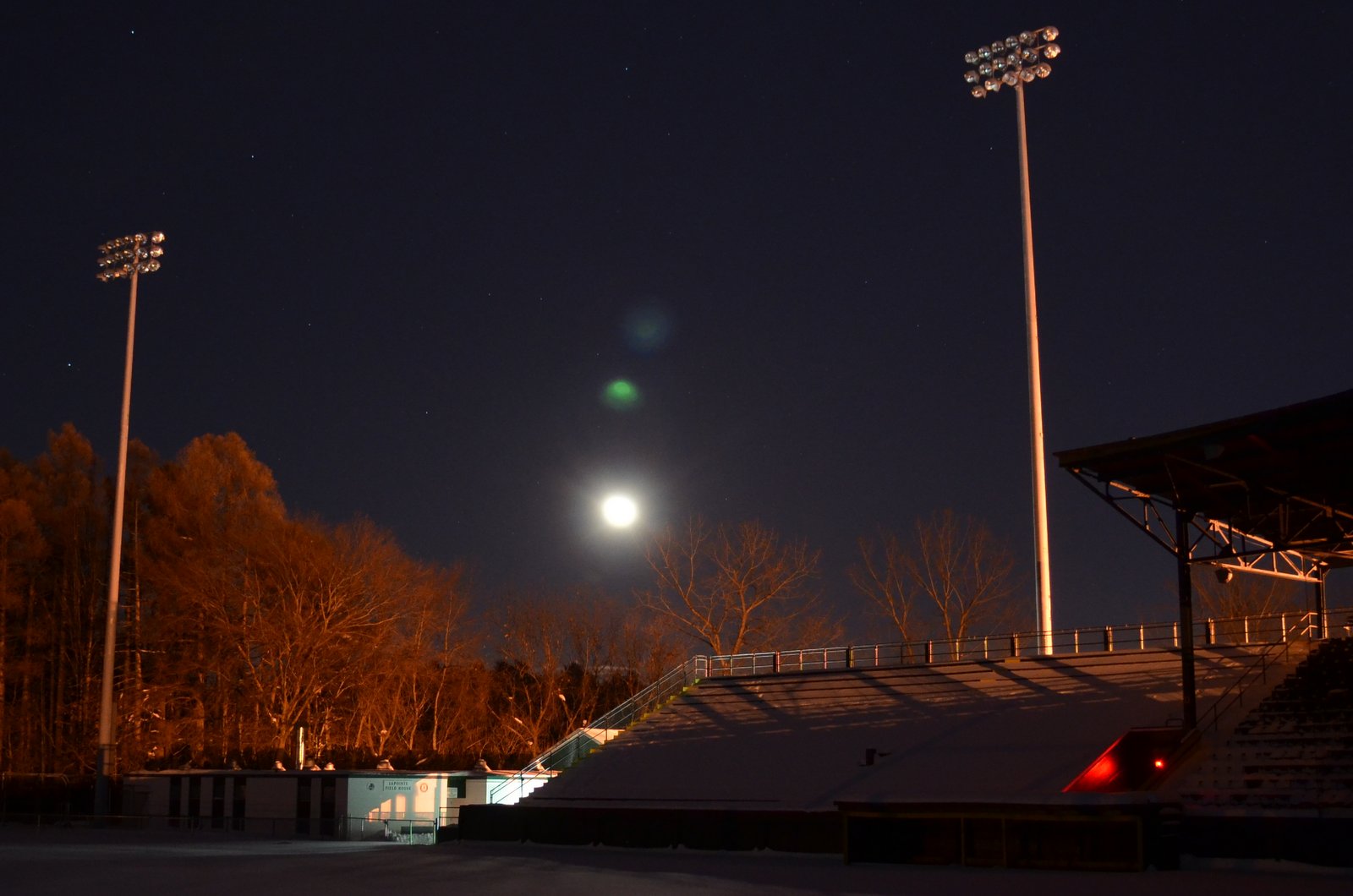
Wednesday - Crosses light post around 11:50pm
Thursday - Crosses light post around 12:40am 
Here's the second thing I learned from photographing the moon last week, and this is visible in this set of photos here, is that the altitude of the moon in the sky changes when the moon as at the same bearing (direction on the compass) on each of the nights. That is, the arc that the moon follows across the sky each night is different. At this point in the lunar cycle, with each successive night the moon travels a slightly lower arc across the sky. I haven't the foggiest why this is, but it indicates that the moon's orbit around the earth isn't fixed. So the sun does this on an annual cycle (sun is lowest in the sky at Winter Solstice, highest at Summer Solstice), but the moon appears to do this on a lunar cycle. And why doesn't the moon just slip out of earth's gravitational field if its rotational axis wobbles around so much? And why does the moon always face us from the same direction?

Monday, January 7, 2013

Starling murmuration


What: On Friday, Brian, Meryl, Julia, Cecily and I went down to Snake Mountain for my sister's birthday. On the way back, we spotted a murmuration of starlings at the intersection of Mountain Rd and Rte 17 in Addison. 

We were mesmerized. Even watching the video, I kind of just sink into this lull where time dissipates. My naturalist mind drifts in and out, and I occasionally puzzle through how and why these brilliantly colored birds congregate in such a way, but my mind drifts just as quickly back into the gentle rhythms of the birds moving like fish through the sky. It's one of the most dramatic and muted winter events. Perhaps their banality (there are about 2/3 as many starlings as people in the United States) makes something like this easier to ignore.

Ecological notes: We watched them flying endlessly back and forth in these beautiful organic, fluid streams for about 45 minutes. The smaller flocks would drift in and out of one another, occasionally number in the 400-600 range, then splinter back into groups of 20-100. Very rarely would a starling be flying by itself. One of the more beautiful moments was when a flock would fly over the cattle barn, with a smaller group slipping off into the barn to roost. By the time we left (5pm) there was a cacophonous roar coming from the thousands of starlings in to roost for the night.

It seems like energy conservation is particularly important during the winter, and so this seemingly extravagant display appeared out of place. My initial guesses felt off - could they be socializing? having fun? bonding? vying for rank? Crows roost in such large numbers to stay warm, to socialize, and as I forgot while looking at the starlings, to avoid death by owl. It wasn't until a Cooper's hawk showed up that it started to make sense. When the starlings flap their wings it's visually confusing, and makes it hard to focus on any one bird. They constantly shift directions, in near perfect unison, and as they do their bodies go from fat round silhouettes, to thin slivers barely visibly against the flat light. The Cooper's hawk was there nearly as long as we were and made about a dozen attempts at catching a starling, each time returning to apex of the roof empty taloned.

I doubt it's as simple as predator avoidance (this works similar to dazzle camouflage which I wrote about in my post on locusts). The grace and elegance of the birds flying has it's own peace and quieting energy. Their movements etched these soft liquid lines in the still dusk air of winter, and it just felt good to be in their presence. Maybe it's the goodnight story of the starling. Maybe they do it simply because it's beautiful - like the revival chorus of songbirds in August, or the midnight singing of the hermit thrush, or the fall peeping of the spring peepers. Whatever the reason it was another way to fall in love with winter.

Where: Addison, VT. There's a considerable number of cows in that area (here's a link to where we saw the starlings).

Other notes: My sister, Meryl, is a fantastic film maker and cut together the video from footage she shot with her iPhone. For more of her work, visit: http://www.meryloconnor.com/

Saturday, January 5, 2013

The moon (Part II)

What: As a follow up to my last post, I wanted to post about why the moon cycles at all from new to quarter to full and back to new in 28 days. To get a sense of this myself I went out to Centennial Field the past three nights at 10pm, 11pm, and 12am to take photos. Below are the shots from 11pm on Tuesday, Wednesday, and Thursday nights. In New England, about half the days are good for viewing stars, so I was happy to get at least some shots of the moon between cloud breaks (Wednesday was easily the best, but it was super cold, last night the moon wasn't clear until the clouds broke around 12:20am).

Taken on Tuesday night at 11:03pm
Taken on Wednesday night at 10:58pm
Taken on Thursday at 11:00pm, moon hadn't risen yet
Two things come up in this. Apart from the lighting being totally different in each photo, note the different positions of the moon. This is true in two ways. First, the moon appears at a different bearing (direction on a compass) in each photo even though they were all taken within 5 minutes of each other on each night. Put another way, it takes a little longer than 24 hours for the moon to rotate a full 360o around the earth.

I remember that my calculations over a long period of time in Santa Barbara indicated that the time difference for the moon to get to the same bearing (not height, or altitude, but compass direction) in the sky was offset by about 52 minutes later each night. So each night the moon rises about 52 minutes later than the previous night.

For the moon to return to the same bearing in the sky at the same time of day/night, which is the same as completing a full revolution around the earth, it would take 24 hours (a full cycle) / 52 minutes, or approximately 28 days. 

Thursday, January 3, 2013

The moon


What: I've been trying to pay a bit more attention to the moon the past few months, and the last couple of nights I've returned to a project I started when I lived out under the stars in Santa Barbara. Astronomy completely perplexed me and I couldn't really understand anything I was reading about the moon so I decided to put the books down and just do my own research.

Here's what I've learned so far from observing the moon:
  1. The moon doesn't rotate along its own axis. Every night, regardless of phase, time of year, etc. the moon is always facing us with that same sonorous "face".
  2. It takes the moon longer to rotate around the earth than it takes the earth to spin in a full circle.
  3. It takes a little less than 53 minutes longer to reach the same point in the sky on each successive day (53 minutes goes into 24 hours about 28 times - each day the moon is 53 minutes further behind, after 28 days it has made a complete revolution)
  4. As a result the moon is in a different position relative to the sun by the time we can see it each night, resulting in a different "phase" of moon (I'll post a crummy drawing in a couple of days that will show this)
  5. If the section of moon that's lit up is on the west side the moon is waning (getting smaller), if it's on the east then it's waxing (getting bigger).
  6. On a full moon, the moon rises just as the sun sets, and sets just as the sun is rising
Photo I took of the full moon in October, 2012, compare with
the image of the waning gibbous moon, above right
I may be wrong on some of this so feel free to fact check me (just no using books). Nate (aka Gull, aka woodsmen drums smith) and I were just talking about the difference between smartphone apps like Moon Phase or websites like the moonrise finder and using primary experience to find things out. I think it's in the moments between finding the answers that are so important, like hearing the steel girders of the baseball stadium awning creak and groan and rumble like the belly of a ship as the temperature dropped (just as I could watch the moon move, I could almost feel the temperature drop from 2oF @ 7pm to -5oF at midnight). Using an app I would have missed the shooting stars blazing streaks across the sky. Perhaps in the end the information gleaned is the same, but the process is entirely different and I greatly prefer the long road, which is always home to many many divergent paths.

Other notes: Gibbous comes from the Old English "hump" or "hunch" and was used to describe hunchbacks before it was used to describe the moon.

Tuesday, January 1, 2013

Happy New Years


What: Snow! Everywhere! And what a treat after last year. I've been enjoying the wonderful snow piled up in Centennial Woods and pretty much everywhere - and with a few days for it to settle, shift, and change, there are so many different types. I started making blinds for my window and needed some more Phragmites, so I went out with Meryl and Nate around dusk to harvest. We were gifted with a beautiful sunset and we went to the baseball field for a better look. I took the above facing almost due east through the powerlines. The summit in the back is Mt Mayo (which is just south of Mansfield, between Clark and Bolton). The pink light was just radiating off of everything, settling a peaceful quiet over the pines, oaks, and maples. There was a scattering of wispy cumulus breaking up as they were heading southeast.


Ecological notes: I got a bit of tracking in after all that snow. The deer were already on the move Friday night. By Saturday there were tracks from red foxes, mice, and a weasels. Winter brings so many new interests - I've been particularly fascinated by all the different types of snow and I'll be posting on that along with winter buds this month! So stay tuned.