Showing posts with label astronomy. Show all posts

Monday, January 28, 2013

Full moon


I wanted to post a quick note about the moon since it was out in such dramatic form tonight, and I was feeling really grateful for all the cold weather that seems to have helped cleared the air, and made everything feel a little more alive in a weird way.

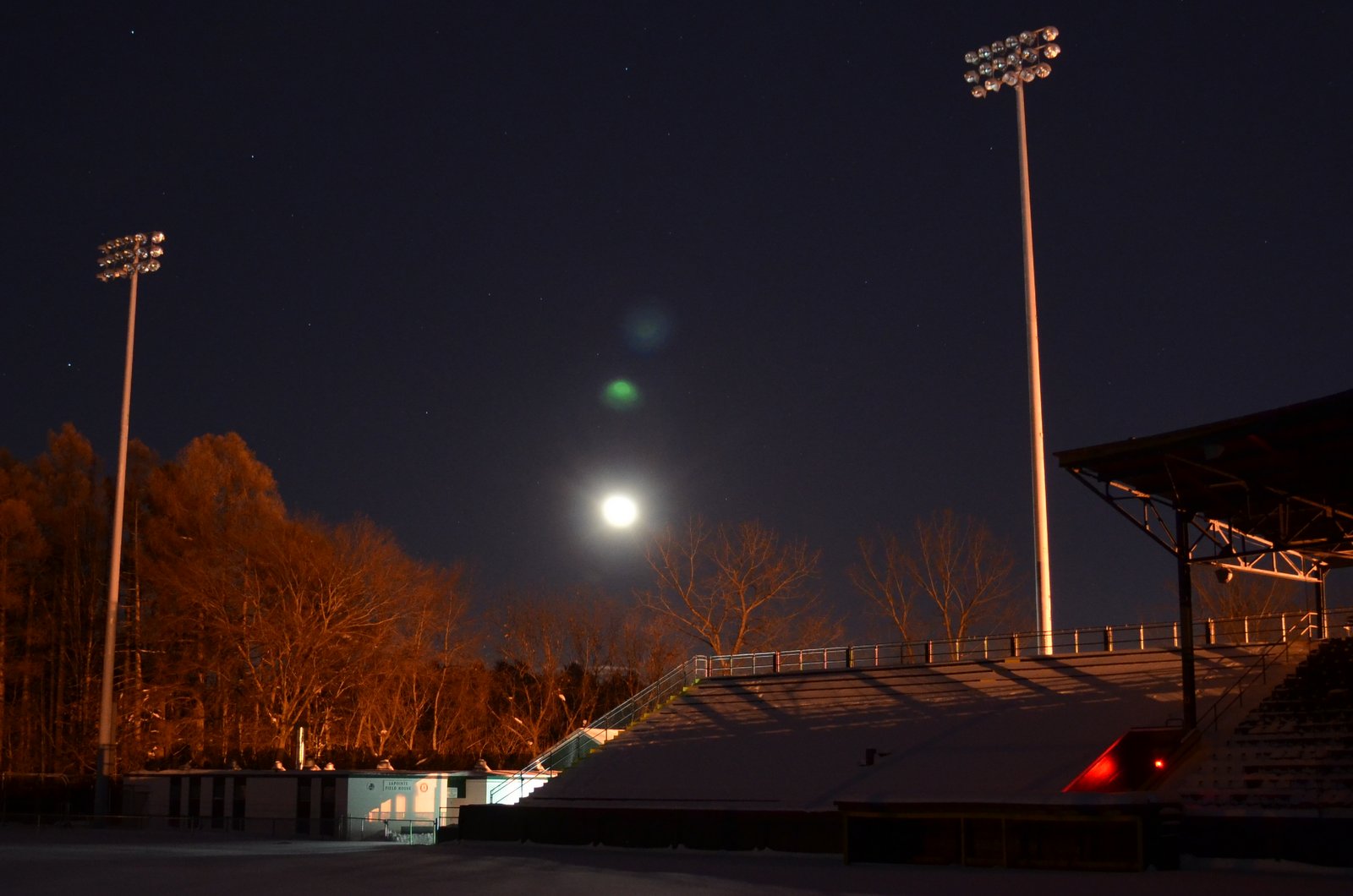
I know the full moon was Saturday night, but it definitely seemed fuller tonight. I had the great fortune of driving due west from about 6pm - 7pm on my way back from Troy and got to watch the moon rise up over the southern part of the lake. In that hour the moon shifted from the deep yellow of a wolf's eye to a striking - almost blinding - white, much like the morning reds, pinks, and oranges giving way to a clear, light blue in the middle of the day (boring explanation: the color shift has to do with the amount of atmosphere between the viewer and the moon - blue gets absorbed first, but giving enough atmosphere longer wavelengths, like red, get absorbed and we are able to see them since they overshadow the blues).  

You can notice the slightest wavy part of the top of the moon, which is actually a shadow, revealing the ever-so-slightest crescent carved out of the moon. The chunk was on the trailing end of the moon's path in the sky, indicating that the moon is waning. And, the photo below is a weird phenomenon -that offset green mirage of the moon - I've noticed a couple of times while photographing full moons.


Monday, January 21, 2013

Orion and why we have a winter sky


What: Following up from a couple weeks back, I wanted to try and draw out in my head (and then on paper) why we have a winter sky. The sketch above is a view looking down on the northern hemisphere of the earth as it rotates around the sun (counterclockwise). The dark part of the earth represents the "nighttime" side of the earth. It might be hard to tell from the drawing but Orion is supposed to be positioned below the earth's axis of rotation around the sun, such that at night it appears to be in the southern portion of our sky.

From our perspective, the sun is fixed relative to Orion (drawn just below the word winter). Earth's position relative to the two celestial bodies changes slight each night and significantly across seasons. The shaded side of the earth (what we call night) always faces away from the sun. So as the earth rotates around the sun, the direction we face out into the universe changes. As we circle around, Orion falls farther and farther away from being in the section of sky framed by the horizon. And pretty soon by the time summer rolls around, the shaded side of the earth faces away from Orion, and all those other winter stars that would appear on the left hand side of the drawing.

All this is comes from pretty basic observations that I'd never stopped to make. Drawing made all the difference for me in figuring out why we have a winter sky. You can also use the above drawing to infer why we have summer in the northern hemisphere when the north pole points towards the sun and winter when it points away from the sun.

Where: Up up up!

Other notes: The full moon is coming up soon and I plan on heading back out to take a couple more photos of the moon at the ball park to get another set of relative photos to gauge how it's arc in the sky has shifted from last month to this month, if at all.

Thursday, January 10, 2013

The Moon (part III)

Wednesday - Crosses light post around 11:50pm
Thursday - Crosses light post around 12:40am 
Here's the second thing I learned from photographing the moon last week, and this is visible in this set of photos here, is that the altitude of the moon in the sky changes when the moon as at the same bearing (direction on the compass) on each of the nights. That is, the arc that the moon follows across the sky each night is different. At this point in the lunar cycle, with each successive night the moon travels a slightly lower arc across the sky. I haven't the foggiest why this is, but it indicates that the moon's orbit around the earth isn't fixed. So the sun does this on an annual cycle (sun is lowest in the sky at Winter Solstice, highest at Summer Solstice), but the moon appears to do this on a lunar cycle. And why doesn't the moon just slip out of earth's gravitational field if its rotational axis wobbles around so much? And why does the moon always face us from the same direction?

Saturday, January 5, 2013

The moon (Part II)

What: As a follow up to my last post, I wanted to post about why the moon cycles at all from new to quarter to full and back to new in 28 days. To get a sense of this myself I went out to Centennial Field the past three nights at 10pm, 11pm, and 12am to take photos. Below are the shots from 11pm on Tuesday, Wednesday, and Thursday nights. In New England, about half the days are good for viewing stars, so I was happy to get at least some shots of the moon between cloud breaks (Wednesday was easily the best, but it was super cold, last night the moon wasn't clear until the clouds broke around 12:20am).

Taken on Tuesday night at 11:03pm
Taken on Wednesday night at 10:58pm
Taken on Thursday at 11:00pm, moon hadn't risen yet
Two things come up in this. Apart from the lighting being totally different in each photo, note the different positions of the moon. This is true in two ways. First, the moon appears at a different bearing (direction on a compass) in each photo even though they were all taken within 5 minutes of each other on each night. Put another way, it takes a little longer than 24 hours for the moon to rotate a full 360o around the earth.

I remember that my calculations over a long period of time in Santa Barbara indicated that the time difference for the moon to get to the same bearing (not height, or altitude, but compass direction) in the sky was offset by about 52 minutes later each night. So each night the moon rises about 52 minutes later than the previous night.

For the moon to return to the same bearing in the sky at the same time of day/night, which is the same as completing a full revolution around the earth, it would take 24 hours (a full cycle) / 52 minutes, or approximately 28 days. 

Thursday, January 3, 2013

The moon


What: I've been trying to pay a bit more attention to the moon the past few months, and the last couple of nights I've returned to a project I started when I lived out under the stars in Santa Barbara. Astronomy completely perplexed me and I couldn't really understand anything I was reading about the moon so I decided to put the books down and just do my own research.

Here's what I've learned so far from observing the moon:
  1. The moon doesn't rotate along its own axis. Every night, regardless of phase, time of year, etc. the moon is always facing us with that same sonorous "face".
  2. It takes the moon longer to rotate around the earth than it takes the earth to spin in a full circle.
  3. It takes a little less than 53 minutes longer to reach the same point in the sky on each successive day (53 minutes goes into 24 hours about 28 times - each day the moon is 53 minutes further behind, after 28 days it has made a complete revolution)
  4. As a result the moon is in a different position relative to the sun by the time we can see it each night, resulting in a different "phase" of moon (I'll post a crummy drawing in a couple of days that will show this)
  5. If the section of moon that's lit up is on the west side the moon is waning (getting smaller), if it's on the east then it's waxing (getting bigger).
  6. On a full moon, the moon rises just as the sun sets, and sets just as the sun is rising
Photo I took of the full moon in October, 2012, compare with
the image of the waning gibbous moon, above right
I may be wrong on some of this so feel free to fact check me (just no using books). Nate (aka Gull, aka woodsmen drums smith) and I were just talking about the difference between smartphone apps like Moon Phase or websites like the moonrise finder and using primary experience to find things out. I think it's in the moments between finding the answers that are so important, like hearing the steel girders of the baseball stadium awning creak and groan and rumble like the belly of a ship as the temperature dropped (just as I could watch the moon move, I could almost feel the temperature drop from 2oF @ 7pm to -5oF at midnight). Using an app I would have missed the shooting stars blazing streaks across the sky. Perhaps in the end the information gleaned is the same, but the process is entirely different and I greatly prefer the long road, which is always home to many many divergent paths.

Other notes: Gibbous comes from the Old English "hump" or "hunch" and was used to describe hunchbacks before it was used to describe the moon.