Showing posts with label red rocks. Show all posts

Thursday, May 2, 2013

Spring ephemeral a day - Hepatica

Shelburne Bay


What: The most fascinating thing for me about hepatica is that as it comes up some of the leaves don't quite make it above the leaf-litter, or make it just part way. Where the leaves are exposed to the sun they are a dark purple, while the shaded parts are a bright green.


Another common adaptation of spring ephemerals is fuzziness (lots of species of ferns have some similar adaptation covering their fiddleheads). The fuzz is analogous to the loft of a down jacket. It creates a buffering layer around the plant. I'm convinced that this layer - ecologically called a boundary layer - is one of the most significant factors that plants and animals have adaptations for. We experience a boundary layer in cold water. If we stand in calm cold water we feel it get warmer and warmer the longer we stand there. Our body heat radiates out and warms the water, effectively increasing our boundary layer. The boundary layer can dwindle if we start walking or if the water is moving (e.g. wind action or water flow in a river). Wearing a wetsuit creates a thin boundary layer between the suit and our bodies that helps warm us.


Regardless of how strong the wind or current is, we always have at least a thin layer of no friction around us. It's why even on the highway, that layer of dust stays pressed against the hood of our car. It's also why at the top of Camel's Hump, all the plants hug close to the rocks to shelter from the wind. It's also why the reproductive part of the moss up there sticks up above the moss, to get out of the boundary layer and let the wind drag the spores away.

Monday, April 29, 2013

Spring ephemeral a day - Early meadow rue


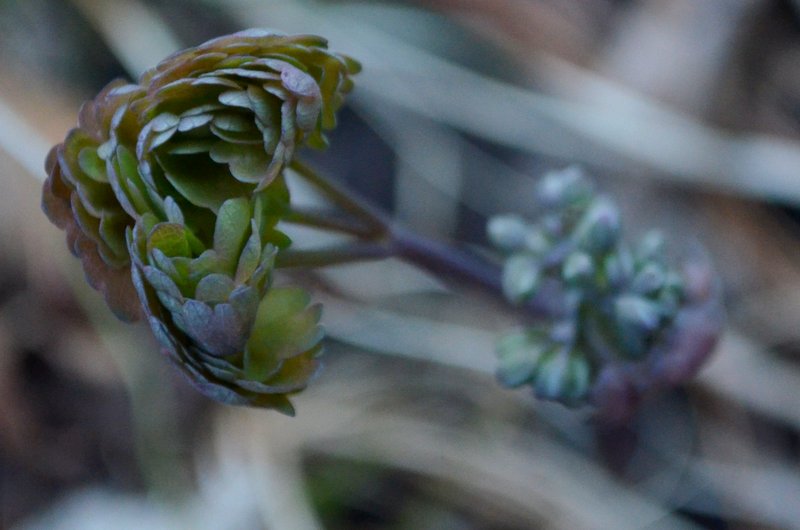
What: Last Wednesday, Leah, Sophie, Brooke and I took an early morning trip out to Red Rocks. The sunrise was gentle and elegant over Shelburne Bay. It was serene watching the ring-billed gulls cut lines across the water. We watched a few lines of cormorants heading north. Beneath our feet, we enjoyed the first of the spring ephemerals shivering their way up in the leaf litter. I was particularly captivated by the beauty of the early meadow rue (Thalictrum dioicum) unfurling into itself.


Ecological notes: Early meadow rue is superficially similar to blue cohosh (Thalictroides caulophyllum, thalictroides = thalictrum: thaliktron, Greek name for plant similar to meadow rue + -oides: resembling, looks like, so blue cohosh is the plant that looks like the plant that looks like an unknown plant that Dioscorides described in Greece). Blue cohosh looks like a beefed up, simplified meadow rue (I'll post about blue cohosh soon). Besides the shapes of the two plants being similar, the most notable similarity is their color. Each emergent plant has a deep purple tint to it. As the plant unfurls, it loses this coloration. My guess would be that, as a tree's leaf has yellows and oranges and other fall colors throughout the growing season, they don't show these colors during the growing season as the density of green chlorophyll increases and overshadows other colors in the leaf.


Where: Red Rocks, growing along the cliffs under scattered white cedar (Thuja occidentalis) and common red cedar (Juniperus virginiana).


Other notes: When I was first learning plants, I didn't know about Newcomb's wildflower guide and was more or less on my own. So I just made up names for them. This was the only plant I remember. I called it bear paw because the leaves reminder me of happy little bear feet dancing across the forest floor.