Showing posts with label identification. Show all posts

Tuesday, March 10, 2015

Dichotomous key (I) - Branch pattern (phyllotaxis)

Opposite apical buds on winged euonymous (Euonymous alatus)

Dichotomous: Dikho (Greek: two, apart) + -tomia (Greek: cutting)

Given my familiarity with the gross anatomical features of twigs, I was ready to dive into identification by learning the specifics. It would be in my ability to discern variation in the different features that would allow me to use a dichotomous key and identify the twig of concern. A good dichotomous key is indeed a rare thing. Many field guides (most tree ID books) lack them because they often require highly technical language, making them difficult for neophytes (pun intended) to use. But they are incredibly useful as they force the observer to look and look again. Making good dichotomous keys (for anything) requires the following:
  1. Finding categories that you can use to lump the things you're studying into the largest groups possible. These categories will have to be binary. For humans, you might start with something like gender, or eye color. You wouldn't start with obscure characteristics, like has four fingers since this would give you two very uneven sized groups.
  2. Avoid relative characteristics (like big, frail, etc.) and be specific with numbers where possible
  3. Come up with characteristics that have only two answers. Essentially, you're creating two groups repeatedly until there's only one item in each group. So blond and not blond, male and not male
  4. Start with easy to observe characteristics. Things get harder to split into groups the more specific you get, so start with things that are simply and easily observed
Remember too that a dichotomous key is only as good as the person who made it. These are some of the potential hazards of a dichotomous key:
  1. It relies on a characteristic not present on your specimen (mature bark deeply furrowed when you only have a sapling)
  2. It uses something clear to the author not clear to the user (e.g. too technical of language)
  3. Lack of clear contrast in characteristics (flowers red vs flowers pink)
  4. Uses relative or subjective characteristics (e.g. plants tall)
  5. One group is a clump of multiple characteristics (flowers yellow vs flowers white, red, or absent)
  6. The plant you have is not in the key! Plant ranges have changed over the years and an old manual may say your plant only grows south of Massachusetts. 
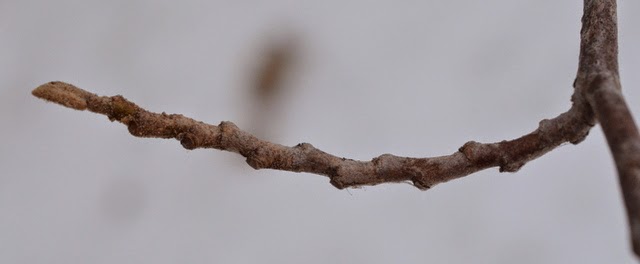
Rather than rewrite a dichotomous key, I wanted to focus in on the attributes of some of the key features used to identify plants by their twigs. A common way to start with our trees is evergreens vs deciduous trees but I skipped that since for now I'm just focusing on hardwoods (synonymous with deciduous and broad-leafed). The next most common way of lumping them is to look at branching patterns. For our broad-leaved trees, branches can be arranged in one of four different ways.

Witch-hazel (Hamamelis virginiana) bud showing exagerrated zig-zag of alternate branching

Alternate
Each node - part of the stem where the buds originate/leaves attach (the internode, the space between two nodes, is nearly absent on spur branches) - only contains one lateral bud.

Opposite branching in white ash (Fraxinus americana)

Opposite
Each node contains a pair of lateral buds.


Sub-opposite branching in glossy buckthorn (Frangula alnifolia),
 buds are paired, but not directly opposite one another

Sub-opposite 
Each node contains a pair of buds, though they are not directly opposite one another on the stem. This often will occur on rapid growth of plants that are typically opposite. 

Catalpa (Catalpa sp.) branch showing two shoots and leaf scar coming out from same node

Whorled
Each node contains three or more buds. The least common branching pattern. We only have two species of hardwood trees/shrubs in Vermont with whorled branches. Catalpa and buttonbush. 

Sunday, March 8, 2015

Twigs


The end of winter is rapidly approaching and before it does, I wanted to take a last minute inventory of twigs. In identifying twigs, I've found dichotomous keys to be extremely helpful, but rarely use them while out in the field. When identifying species in the woods I also typically don't use the same thinking to identify twigs that I would while using a key at home, perhaps because I'm not as skilled as a botanist and don't have the familiarity with the technical aspects of twig ID to call it up in my head. This became more obvious while out at the LaPlatte River in Shelburne.

To start, since I've got some familiarity with twig anatomy, I wanted to photograph the different anatomical parts then create my own dichotomous key to some of the most common in the area. Below are the different aspects of a twig shown on various species moving from the stem of the plant out to the tip. A twig, by the way, is technically all the current year's growth (i.e. everything produced by the tree since bud burst in the most recent spring).

Spur branch on common buckthorn (Rhamnus cathartica)

Spur branch
Spur branches are tiny branches formed from lateral buds and can be several years old. They tend to be found on more shade tolerant species. These species don't put on a lot of growth each year and retain leaves in roughly the same position on the plant year after year (great examples can be found on yellow birch). These are not monophyletic (found on one evolutionary branch), and show up in some conifers (e.g. tamaracks) as well as broad-leafed trees. 

Bud scale scar on red-osier dogwood (Cornus sericea)

Annular scar or bud scale scar
A bud is essentially a mini branch hording tini little leaves and/or flowers flowers inside. Where the bud covering of the terminal bud falls off, it leaves a scar fully encircling the branch. This can often be discerned by finding a clear change in color from the older to the more current year. Depending on the species, this color is apparent going back four to six years.

Spongy pith of white ash (Fraxinus americana)
Pith
Pith is parenchyma tissue. Parenchyma is basically just undifferentiated cells with thin cell walls. You find parenchyma cells in highly active growth areas (like the tips of twigs). In twigs, pith is the origination site of buds. It is typically white and spongy when young, though as it ages it will discolor and break. Depending on how it ages, pith can be solid, spongy, chambered, or hollow.

My fingerprint on whitish bloom protective covering on twigs and 2-year-old growth on boxelder (Acer negundo)

Bark coverings
Some first year twigs are coated in hairs (pubescent), others have a white bloom to them. I still don't know what this white bloom is, but it's the same stuff found on raspberry twigs, grapes, and lots of other fruits like apricots.

Lenticels of boxelder (Acer negundo)
Lenticels
The mouth holes of the tree that open in the cork of tree (cork is the protective outer tissue of the bark). This is where gas exchange happens on the stem of the plant (occurs on the stomata of leaves). Many species have adaptations within the bark to protect the tree from fire, predators, damage from flooding, etc. The thicker bark on these species blocks off gas exchange. Look for lenticels on younger, thinner barked parts of trees. 

Lateral buds off a red maple (Acer rubrum)

Lateral buds
Running up the branch of the tree, these are all the buds that aren't at the tip of the twig. They can be arranged alternately, opposite, sub-opposite, or whorled. Our only deciduous whorled tree here in Vermont is the catalpa (I think). The vast majority are alternate. This is largely a characteristic shared by all members of a given genus. MAD Cap Horse works as a mnemonic to remember the opposite branched trees (Maples Ashes Dogwoods Caprifoliacea - the honeysuckle, viburnum family Horse chestnut).

Bundle scar (black) and Leaf scar (grayish) looking monkey face of a butternut (Juglans cinerea)

Leaf scar + Bundle scar
A petiole connects the leaf to the branch. Petioles come in a wide range of shapes from the u-shape of celery stalks to the flattened wagging stems of aspen leaves. Nutrients are fed into the leaf (and siphoned back down to the roots) via vascular tissue in bundles. When the leaf falls off it exposes bundle scars - the parts where the tubes flow from the stem into the leaf - illuminating the arrangement of these bundles, which is unique to each species. Butternut scars have the appearance of a funny little monkey face.


Terminal Bud
The terminal bud is the apex of the shoot (also called an apical bud). It usually points directly out and is larger than the lateral buds. As with lateral buds, it contains miniature leafs and flowers.

Over the coming weeks I'll be drawing out a dichotomous key by drawing attention to these features and others of some of the more common wild and naturalized species found in my part of Vermont.