Showing posts with label leaves. Show all posts

Saturday, February 16, 2013

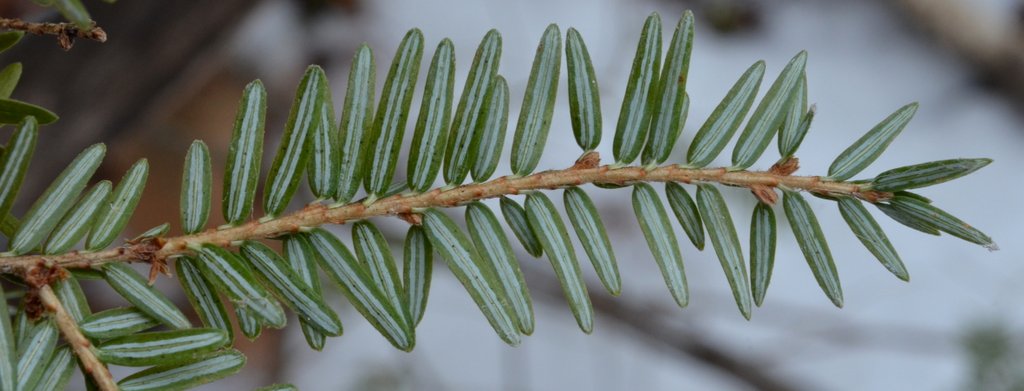
How hemlocks breathe


What: I used to describe the underside of a hemlock needle as being akin to an old classic longboard surfboard. It wasn't until a few years ago that I actually wondered what those little white lines on the underside of a hemlock needle actually were.


Ecological notes: Those two white lines are actually a bunch of little white dots, which are actually the stomata (the mouths, or sites of gas exchange, in leaves).

Because conifers weather out the winter with their needles still on the branches, they have to compete with harsh winter winds for water. They effectively have a water input of zero. With the ground frozen, the tree can't replace any of the water it might lose to transpiration (basically evaporation of water out of any openings in a leaf). Transpiration increases with wind that would carry water vapor away (much like how you can tell wind direction by licking your finger and holding it up; it feels cool on the windy side because the water is evaporating even though it's well below the boiling temperature where you'd expect it to go from a liquid to a gass).

Hemlocks would risk desiccation (severe drying) in the leaves unless it could somehow protect itself from the ways it loses water. It does this in a couple of ways. First, it has a super waxy cuticle. The waxy cuticle prevents transpiration from occurring on the top side of the leaf. Second, it protects the stomata (those openings) from being exposed to the wind by putting them on the underside of the leaf and having them in grooves.


Thursday, April 19, 2012

Little leaves

What: Quiz Time! This seems to be the hardest part of the year for telling which trees are which: the buds are bursting, becoming unrecognizable, and the little leaves, just emerging, haven't quite yet taken full shape. It's like looking baby photos of friends and trying to guess who they are. The leaves in the photos below are some of the early ones to come out. Roll over each to test your ID skills (there are both shrubs and trees). 

Quaking aspen (Populus tremuloides) Alternate leaf dogwood (Cornus alternifolia)
Common buckthorn (Rhamnus cathartica) Red maple (Acer rubrum)
Staghorn sumac (Rhus typhina) Norway maple (Acer platanoides)
Male boxelder (Acer negundo)Boxelder (Acer negundo)
Siberian elm (Ulmus pumila)

Ecological notes: You can compare the male boxelder shown above to the female boxelder from my post on boxelder bugs. Also, the last photo shows the seeds from an ornamental Siberian elm in Centennial Woods. Ryan Morra and I were pondering over greenness of the seeds. One possibility is that they're actually photosynthetic when they're young (boxelder, white pine, oaks, walnuts, and probably other seeds that invest a lot in endosperm are also green when young). I would imagine that this would take away pressure on the leaves to produce energy for the developing seed. In the elm photo it's a fly on the seed, but other pests can destroy a seed. If leaves were producing energy for growth, winter storage, and the seed, they might be more likely to be at a net loss each year. Having seeds responsible for their own growth is energy insurance for the rest of the plant.

Spoiler alert: The species above are, in order, Populus tremuloides, Cornus alternifolia, Rhamnus cathartica, Acer rubrum, Rhus typhina, Acer platanoides, Acer negundo, Acer negundo, Ulmus pumila.

Other notes: Just a pattern I noticed - willow family and maple family seem to be among our earliest trees to leaf out. Big-tooth isn't out yet, birches are barely opening up, and the buds on some of our more southern species are only beginning to open (e.g. walnut, oak, hickory)