Showing posts with label natural history mystery. Show all posts

Thursday, November 29, 2012

Red Spotted Newt

Posted by Sophie Case. Sophie is a senior Environmental Studies student at the University of Vermont. She loves speaking Spanish, cooking fresh and delicious foods, and playing music. 

While hiking in the woods one dreary fall afternoon, something flashy and bright red caught my eye. It was scurrying across the ground quickly, and stopped for a quick break on top of a branch. I took a closer look, and realized that I had never seen this creature before. It looked like some sort of salamander, but I wasn?t near any running water. I quickly snapped a picture, and decided to investigate further once I got home.

As it turns out, the creature I saw was a red eft (Notophtalmus viridescens), which is the the juvenile stage of a red spotted newt, also known as the eastern newt. I found that the red spotted newt is actually quite common in North America, and tends to live in small lakes, ponds, streams, or wet forests. The range for these newts extends from South Ontario to Nova Scotia and as far south as eastern Texas and Florida. The adult stage of the red spotted newt lives mostly in aquatic environments, while the juvenile stage is a terrestrial creature. Adults range in color from from olive to brownish green, have red spots on their back, and yellow bellies. Red Efts have a completely bright orange or red body.

Red spotted newts breed in April and May. Breeding is instigated by the male who attracts the female newt to him with his bright red spots. He then releases and odor while wiggling, which further attracts the female. The two mate and lay eggs that hatch in three to four weeks. Thus begins the three stage life cycle of this amphibian. The first stage is aquatic larvae (the eggs), the second stage is terrestrial efts (the red eft), and the third and final stage is the aquatic adult. Female red spotted newts lay between 200 and 400 eggs. Once the eggs hatch, the efts spend most of their time hunting.

Their diet consists mainly of caterpillars, invertebrates, spiders, and flies. Red Spotted Newts are one of the easiest newts to keep as a pet, as far as maintenance goes, but one has to be aware that they can live up to 20 years, so it may be more of a long term investment than most pet owners are ready for. Although the ref eft isn't too uncommon to see around the woods, I was excited to see a bit of wildlife on a rainy autumn day!

Monday, November 26, 2012

Free Masons

Posted by Hannah Brill. Hannah is a Sophomore at UVM in the Environmental Program. While walking through the Green Mount Cemetery in Centennial Woods, a symbols engraved on one of the gravestones caught her eye. She decided to dig a little deeper and found something much more interesting then expected.


As I walked through Green Mount Cemetery here in Burlington I noticed a peculiar symbol embossed on one of the fancier gravestones, which belonged to the Spafford family.  The symbol is simple: a “G” engraved inside a compass and ruler (see image below). This natural history mystery led me to do a little research behind the peculiar symbol.

Once I began researching more about this mysterious symbol I opened a door into a much more peculiar world then I had expected. The engraved symbol belongs to the Freemasons. Freemasons are an international “secret” fraternity. It’s not very secret because so many people know about it. Five million of them walk among us, globally. They have lavish temples, ancient legends, and roots in the medieval crusades. The creation or beginning of the Freemasons is uncertain but some spectators say they can be traced back to the late 16th early 17th century during the stonemason guild of England, Scotland, and France.

The members of this society are powerful, among the elite include George Washington, Franklin Roosevelt, Harry Truman, Hennery Ford, Mozart, Napoleon Bonaparte, Metro-Goldwyn-Mayer MGM studios, Warner brothers, Fox, the man who created the UN and the CIA and many more. The Freemason society may not be that hush-hush but they do have many secrets that have created a lot of buzz and conspiracy’s surrounding this enigmatic club.

This organization has caused a lot of commotion over the years. Their secret rituals, handshakes, meetings, and lavish temples (their clubhouse) have made others uncomfortable. Because of the powerful elite nature of the members and the secrets they have kept for centuries has created many conspiracy theories against the freemasons. One in particular that really caught my eye was the idea that this group is actually a secret government within our government.

Some suggest that Freemasons established America to be a country of their own that they have secretly controlled since the American Revolution. There many “coincidental” occurrences that have had people wondering how true this may be. George Washington, our first president, was an avid Freemason. Above is a picture of George Washington at the laying of the cornerstone. He is all decked out in Freemason wear, an apron, their compass and ruler symbol, and a gavel. Since then one out of every three United States presidents have been members of the Freemasons. The gavel, used in our current judicial system is a major symbol of freemasonry, coincidence or not?

Also while researching I found a very mysterious Masonic connection on the dollar bill. As you can see if you circle the M A S O N and connect them with lines they create a seamless star of David, or pagan star (both common symbols of Freemason.) Also, as mentioned above, the creator of the UN and the CIA were both invented by a Mason. This may or may not be a coincidence but it sure has created some conspiracy theories that the Freemasons have been in control of the country, government and economy.

Any man can be a Freemason. He must ask to be one, Freemasons never ask you to join. They are a group based on moral systems and beliefs in God. All religions are welcome however one must have a religion. Some regard Freemasonry as a religion but they disregard that accusation. Even though the inside of their Grand Lodges look a lot like churches. Inside the lodge is an alter with a volume of sacred law and sacred books of whatever religion those masons believe in. Once you decide to become a Freemason it is a life altering commitment. It is an attempt to be reborn and become a new person, a Freemason; a good and moral person they emphasize. That sounds a lot like religion to me, or maybe it is just another coincidence.

There are three degrees of masonry; entered apprentice, fellow craft and master mason. At every level the mason will learn another secret pass code that will allow him to enter his next degree. However, this pass code must be kept secret just like everything else they learn. If you break your oaths as a Freemason you will be murdered (well at least there are historic records that support this).

This organization is based off and continues to grow off elaborate secrets.  It is hard to describe what exactly Freemasons are because a lot of it is speculative and pieced together from leaked secrets. We can however identify that the members of the largest single organization that is secret happens around the world and holds some of the most richest and most powerful men on earth. These people may or may not have dark agendas and have invisibly controlled and produced our current day society. So now when you see Freemason symbols on bumper stickers, flags, gravestones, t-shirts, buildings, etc you will know that there may be more to those images then the eye can see. It’s a society built off secrets non-masons may never know.

For more information, you can watch this documentary on the Secret History of the Freemasons

Thursday, November 15, 2012

Marcescence in beech trees

Kaleigh Wood is a senior Environmental Studies in the Rubenstein School at UVM. She enjoys exploring outside, running and cooking.

A couple of weeks ago I was on a stroll through Centennial Woods (CW) for a class assignment. The leaves littered the ground with their colors and gave my steps a pleasant crunchy sound as I made my way deeper into the woods. I looked up to find that most of the trees had shed their leaves. I kept walking and suddenly I was surrounded by this beautiful tree that was still full of its vibrant orange leaves. While I haven't taken dendrology and my tree identification skills are sub-par, I did know this one. The tree that was still holding onto its exciting leaves was an American Beech (Fagus grandifolia). I started to wonder, why do Beech trees hold onto their leaves after all the other deciduous trees let theirs fall?

I went on a run with my trusty running buddy, Lily Morgan, who happens to have a strong passion for trees. I was explaining what I had seen in CW and started to ask her what she knew about the American beech; she started rambling some things in Latin and I quickly stopped her and asked her about the leaves and why they stayed on for so long. She gave me a lesson from Reading the Forested Landscape by Tom Wessels on beech. We found out that beech and oak trees are actually somewhere in between evergreen and deciduous trees, explaining why those tree species can hang on to their leaves throughout  the winter.

We wanted to know more, we found out the genetic reasoning why Beech can hang on to their leaves, but what was the ecological advantage of it? I explored the internet and found an article in Northern Woodlands magazine. The author, Michael Snyder, (who is the Chittenden County Forester in Vermont) explained that some plants will retain dead plant matter, known as marcescence. It turns out there are many theories to the advantages of marcescence. One theory is it’s an adaptive advantage for trees growing in dry and infertile areas (where Beech trees grow!), because if they do not drop their leaves onto the ground they deprive the soil of organic matter which other trees need. Beech and oaks don't need the added nutrients so they  continue to thrive. Keeping leaves on their branches and not on the ground allows them to out-compete other species surrounding them. Additionally oak leaves are high in tannins and reluctant to decompose, further reducing available nutrients to other would-be competitors.

Other advantages of marcescence are, trapping snow which leads to more moisture at the base of the tree, the dead leaves on the limbs protect buds from frost in the winter, and finally the leaves can protect the trees from browsers such as deer and moose. The dead leaves can hide buds so they are less likely to be eaten and are more likely to grow new buds and twigs in the spring. Not only do Beech trees provide CW with great views after most trees have dropped their leaves, but there are also advantages to this interesting adaptation.

Monday, November 12, 2012

Norway Maples in the US and Centennial Woods

Posted by Maxwell Siegel- A junior in the Rubenstein School at UVM who is interested in environmental studies, and specifically sustainability studies. Forests and nature in general has always been a passion of his worth pursuing.

The Norway maple (Acer platanoides) is an extremely common species of tree across the United States, whether they line urban avenues, or make up large portions of deciduous forest. One begins to wonder, “Why is a Norway maple growing in North America?” Most Americans are accustomed to the look of the Norway maple and do not question their presence in the United States. In fact, the leaf of the species is the trademark icon for my hometown of Maplewood, New Jersey. The Norway Mmaple is the maple that suburban and urban Americans think of. But when did this species make its way from Europe to North America, and how did it become so popular and widespread?

According to the USDA Forest Service Norway maple is the most widely distributed native maple in Europe, existing in locations with elevations ranging from 0-6000 feet. The first Norway maples made it to the United States in 1756 but were relatively rare until the late 1800s when their popularity exploded. There are several reasons for the cultivation and spread of Norway maples throughout the Untied States. The first being the aesthetically pleasing color and shape the species presents, as well as its extremely immediate and sustained accelerated growth patterns. The species is well adapted to urban environments as it can withstand “moderate pollution, dusts, pavement and dry soil” (USDA forest service), making it an ideal species for lining urban and suburban streets and landscaping properties. They provide ample shade and can quickly become the centerpiece of a yard.

The true boom to the U.S Norway maple population came after Dutch Elm Disease decimated the Elms across the nation, including all of the Elm that had previously lined roads. The urban landscaping niche needed to be filled, and thus the Norway maple stepped into the batter’s box and has taken over the continent’s maple distribution and make-up. Here in urban Vermont these trees are quite common and fill their new niche rather well, making up for the disappearance of Elms along roadsides and in yards. Because they are fully capable of reproducing, the have spilled out of the concrete and are filling our forests as well. It can be estimated that Norway maples entered our state between 1860-1900 and “blossomed” between 1925 and 1950. In Centennial Woods, here in Burlington, the Norway maple thrives. It can live in varying soils because moisture is not a limiting factor. The largest Norway maple I have personally seen in Centennial Woods is in the North-Western section of the woods, and can be approximated to an age between 90-110 years old, dating it back to somewhere between 1902-1922. Another stand fills the gaps in an area that was selectively logged in the late 60s, regeneration from those first Norway maples that had since matured.

It is difficult to determine whether or not the species should be considered “invasive” or not, only because it can out compete native maples such as sugar (A. saccharinum) and red maples (A. rubrum). The diversity of maple species in Centennial Woods seems evenly distributed, however with more research a more accurate depiction of the impact of Norway maples could be determined. But that is for another time!

Wednesday, November 7, 2012

Holy Crows

Posted by Jess dePiano. Jess is a junior ENVS major/Ecological Agriculture minor in the College of Arts and Sciences, and is very interested in ecology and wildlife conservation.

What: Centennial Woods is a great place to observe some pretty dramatic phenological changes that are occurring as we approach the winter months. By now, pretty much all of the deciduous trees have lost their leaves (save the reluctant Norway maples), insects are few and far between, and animals are preparing for the long, cold months ahead. One amazing event that is occurring right now is a mass migration of crows flying over the Burlington area. This daily migration was first pointed out to me by one of my professors at UVM, Teage O'Connor. Seeing this migration over the past few days made me wonder: Where are the crows going? Where are they coming from? Why are they traveling in such large groups (sometimes in the thousands!)? I decided to do some research to look into these questions.

The American crow (Corvus brachyrhynchos) generally migrates short-distance during the winter months. The crows that we are seeing flying over Burlington are traveling to a communal roost (possibly near Red Rocks) where thousands of birds can be found roosting each night. This type of behavior is typical of American crows at this time of year, although to the observer, the sight of hundreds or even thousands of birds flying overhead is extraordinary.

Crow behavior is fascinating. These birds are extremely intelligent creatures, although some regard them as nuisances. Crows travel and forage for food in family groups year-round. When winter approaches, however, massive flocks form and migrate together to roosting sites, like the one here in Burlington. Over the past 60 years crow roosts have become increasingly urban and increasingly large (the largest recorded was estimated around 2 million crows). The sheer number of crows roosting together provides them with protection from predation (strength in numbers!), warmth, and the chance for adolescents to meet potential mates. Also, since crows forage in groups, belonging to such a large group may increase their chances of finding food in the winter. In an urban area like Burlington, the crows have a much better chance at finding food to scavenge and are less likely to encounter large predatory birds (compared to more 'wild' areas).

The migration is a daily one for crows, some traveling well over 10-20 miles to get to Burlington. They arrive in the evenings in a steady stream from around 3-5pm. As winter progresses, we should expect to see more of these birds migrating in the late afternoon into Burlington in search of shelter. If this winter proves to be especially harsh, crow populations may reach over five thousand. If you get a chance, take some time out of your day to watch this incredible event. I personally have never seen anything like it!

Where: Burlington, VT

Sunday, November 4, 2012

Pine borers

Posted by Aaron Rosenbluth. Aaron is a sophomore from Cleveland, Ohio studying Natural Resource Planning and Economics. He loves being in the outdoors and is happily a member of the UVM outing club!


What: Two months ago I was in Centennial Woods leaning against a fallen tree taking notes. The sun was out and I couldn't have been happier listening to the summer grasshoppers sing and birds above me chirp. After almost a half an hour out there, I looked behind me at the tree I was leaning against and realized I was leaning against a phenomenon that I've seen countless times over the years, but have never really thought twice about. What I saw was a simply massive maze of tunnels/passages in the wood. The tunnels weren't very deep down - just under the bark layer - about 1cm deep, but it was a fascinatingly huge and sprawling system. I figured these tunnels were created by some sort of insect species, but which one and how and why?

After some preliminary research I quickly realized what type of species I was starting to investigate; species within the realm of wood-borers, or species which eat and destroy wood (Xylophagous species, from Greek "xylon" for wood and "phagus" for eater). These species range considerably in their characteristics (as well as richness, with over 10,000 species of wood-boring insects identified).

  • All make unique patterns or “galleries” where they live and lay their larvae, 
  • all produce and leave behind unique types of frass (excrement from eating wood), 
  • all prefer different species of wood to bore into, 
  • and all prefer different levels of health in the tree's which they choose to bore into. 
Once larvae have completed development, new adults will chew an exit hole through the bark and emerge. These exit holes are either round, D-shaped, or ovular. Typically, these wood-borers are insects and arthropod species (beetles, moths, ants, bees) whose larvae are laid in and subsequently mature under the bark layer of trees.

After realizing the tree I was leaning against was once home to massive borer community, I looked around the area (a stand of conifers, mostly white pine and hemlock) and was surprised to find that most of the downed trees in the area had once been host to this same borer species. After researching with Eiseman and Charney's Tracks and Sign of Insects and many hours of poring over internet databases, I was unable to come to a conclusion on exactly what species of borer did this, however I did come to the conclusion that it was some sort of bark beetle of the Curculiondae family within the sub-family Scolytinae (linked at the bottom of this posting is an official Vermont State report on insects which likely contains the correct species). These beetles feed on the cambium layer of trees, creating distinguishable patterns in the inner bark and outer sapwood. It is unlike bark beetles to bore deeper than 3mm into the sapwood layer of the tree, which matches what I observed in my tree. Most commonly, bark beetles will attack a tree that is already injured or diseased, often killing it in the process.


The most basic bark beetle gallery begins with the creation of a mating chamber, from which a female excavates a linear tunnel of uniform width either perpendicular or parallel with the grain of the tree (mine went parallel). On either side of the tunnel, the female creates small little niches and lays an egg in each one. I was able to see these niches in my downed tree species (these were in white pine, Pinus strobus); they look like tick marks that are evenly spread out following the main tunnel (see image above).

Ecological Notes:
Wood borers serve the ecologically keystone task of facilitating tree decomposition by creating holes and channels in the woody tissue, phloem, and bark of the stressed, diseased, or dying trees which they feed on. This allows for fungi to enter the tree and begin decomposition.
http://www.vtfpr.org/protection/documents/FullVersion2009ConditionReport.pdf

Wednesday, October 31, 2012

Spooky Happenings in Centennial Woods

Nathan Hanna is a junior at the University of Vermont Studying Environmental Studies. He grew up in the woods of New Hampshire and enjoys exploring all aspects of nature.

It’s that time of the year again! Goblins and Ghouls are roaming the earth looking to spook wary wanderers and black cats are abundant. Everywhere you go there is bound to be some sort of bone-chilling history, and Centennial Woods is no different. I researched various past events and mysteries that may have you wondering if you are really alone in the woods. I also explored the ways in which the nature of Centennial Woods has played a role and has been affected by these frightening tales.

Story #1
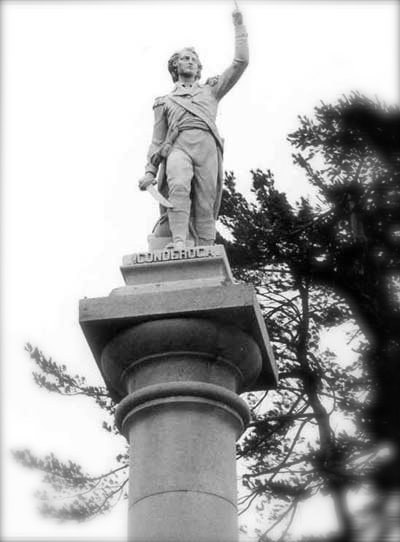
The first eerie mystery involves the Greenmount Cemetery, which borders Centennial Woods and overlooks the city of Winooski. The cemetery dates as far back as 1763 and contains some of Vermont’s most important historical figures. General Ethan Allen, who captained the Green Mountain Boys and fought for Vermont’s independence, has an extravagant, 42-foot statue that was erected in 1873. A plaque at the front of the monument explains that Ethan Allen “was buried near here.” Through this enigmatic plaque, there was confusion as to if his remains were actually buried in Greenmount. In 2000, there was a project to restore the monument, and during this process, workers discovered a crypt buried underneath the monument. Rather than opening the crypt to find out for sure if Ethan Allen’s remains existed at Greenmount, Vermont elected to keep it a mystery in order to protect historical integrity. Avid hiker and Centennial Woods explorer Will Russell recalled a night last winter in which he heard strange noises around Ethan Allen’s grave site. Could this be our past freedom fighter roaming his former land? If you find yourself walking the borders of Centennial Woods near the cemetery, especially around this time of year, keep your eyes peeled for any ghostly happenings!

Ecological Notes:
Graveyards include an abundance of flora, and Greenmount Cemetery boasts a wide range of plants and trees over its fifteen acres, many of which are native to Vermont. Evergreens such as the white spruce (Picea glauca), white pine (Pinus strobus) and the white cedar (Thuja occidentalis) provide great coverage from wind and snow for the graveyard. Other aesthetically pleasing species present include the paper birch (Betula papyrifera) and the red maple (Acer rubrum).

Story #2
Another frightening story includes a body that was found in the woods just one year ago. A woman was out walking her dog when she happened upon a dead body wrapped in a blanket. To this day, nobody knows for sure what happened to this man. Perhaps it was due natural causes, or maybe something in the woods got him. The harsh winters of Vermont have been known to swallow up innocent souls and leave bodies strewn on the cold hard ground.


Ecological Notes
Plants and wildlife have to fend for themselves every winter, and some do this better than others. Beavers for instance, adapt well to cold temperatures. Normally crepuscular animals (active primarily during daybreak and twilight), beavers spend the daytime leading up to winter to build their lodges. Since the surface of the water they live in may freeze solid, beavers will chew down extra trees for underwater food storage. On the other hand, many trees, plants, and animals fall victim to the ice and wind and eventually meet fate of the lost man of Centennial Woods.

Story #3
Photo taken by Gary Allen
Our next spooky tale involves an abandoned ski hill. In the winter of 1962-1963 the South Burlington Rope Tow was opened for operation on what is now Centennial Woods land. The slope was open for a few years before it was mysteriously destroyed and left as a barren wasteland. There were accounts of children playing with fire around the time of the disaster, and it is believed that these troublemakers caused the destruction. Some say that if you head to this section of Centennial Woods on a quiet winter afternoon, you can still hear the raggedy old rope tow and the sounds of old skis running across the snow.

Ecological Notes:
Today, Red Pines (Pinus resinosa) inhabit much of the forest where the ski hill used to exist. The presence of Red Pines suggests past fire activity because red pine regeneration peaks in the years following fires. Fire adaptations include a thickened bark and an elevated crown.

Monday, October 29, 2012

Stars on Earth: How to find them, and how to make them shine

Amanda Spears is a sophomore in the Rubenstein School of The Environment and Natural Resources studying wildlife biology. She is (informally) a field naturalist in-training with a passion for birds.


Centennial Woods is absolutely breathtaking and brimming with life this time of year. . .during the day. But what about at night? Do we all assume that it rests with the sun to prepare for it’s early morning the next day? If you've been in the woods at night then you know that it’s just as awake at night as it is during the day, or rather it’s best described as a re-awaking. Owls, flying squirrels, deer, rodents, opossum, raccoons, frogs, and scores of insects use the absence of light to evade predators, and/or capture prey. Being in the woods at night is admittedly eerie, perhaps because you tend to feel the presence of life, something watching you, that uneasy feeling that you are not alone.

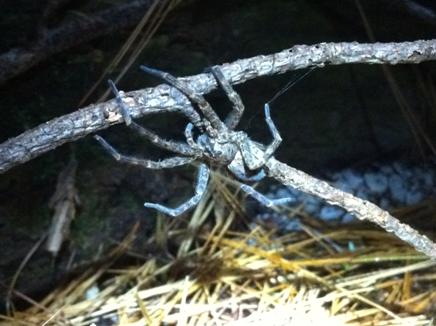
I’ve been out to Centennial Woods dozens of times, during the day of course. Recently, a few friends and I took advantage of a particularly warm evening and headed out for a night hike. We started at the main entrance off Carrigan Drive, and walked in quite a ways, stumbling upon a few bedding deer, and trying to hoot up a Barred Owl. No luck. However, sweeping our headlamps back and forth across the path, every once and awhile a small flash of light would catch our eyes, looking much like a bead of dew catching the morning sun - or in this case our headlamps. It had not rained recently, so what were these twinkling earthbound stars? Curiously we targeted one and walked slowly up to it, and what we discovered awed some of us, and frightened the rest . . .

it was a Wolf Spider!


This particular guy was hanging amongst the leaf litter and debris, perhaps patiently waiting for a meal to walk by. He looks a bit like a mini- tarantula, doesn’t he? So how does he produce that light? We’ve heard that spiders have eight eyes, and as it turns out, the arrangement of those eyes is a way to classify and identify certain spider families. Lycosidae, or Wolf Spiders, have 4 small anterior eyes and 4 large posterior eyes, giving them excellent eyesight to use for hunting, evading predators, and courtship. These eyes are also responsible for producing that glint: light from the headlamp reflects off the tapetum lucidum in the spider’s eyes. You’ve seen this elsewhere, maybe from a deer in your headlights, or even from your cat. The eyeshine from these animals is the same as this spider’s. 

Not all light that enters the eye is perceived by an organism. This is particularly problematic for nocturnal animals. The tapetum lucidum is a layer of cells in the back of the eye behind the retina that reflects incoming light back across the retina, allowing an organism to make the most of scant light at night. Not all the reflected light is absorbed by the retina on its second pass and so the glow comes from the light that "escapes" back out the eye. Those organisms that have a tapetum lucidum are, in most cases, nocturnal. Different colored reflections can be diagnostic for identifying animals at night.

So this Halloween, when you are out and about walking from this house to the next (for whatever reason), remember to bring your flashlight or, better yet, your headlamp. You may be lucky enough to catch a spider’s eye, or eight!

Thursday, October 25, 2012

Bunker in Centennial Woods

Posted by Andrew Mamrak. Andrew is a Junior Environmental Studies student with a focus in ecology and conservation in the Rubenstein School of Natural Resources at UVM

Ever since the very first time I set foot in Centennial Woods, I have been drawn to the large concrete structure beyond the stream, not far from the main entrance off of Carrigan Drive. This rundown pseudo-bunker is clearly not a natural component of UVM owned Centennial Woods Natural Area. It has, however, become a graffiti and spray paint canvas for college students and local kids trying to leave their own mark or message on.

Knowing only a little about the past uses of Centennial Woods from my Natural History of Centennial Woods class, I still did not feel confident assuming that this structure was somehow a part of a past farming or possibly even the old skiing area located a short distance to the southeast. This large and clearly historical piece of human presence in the area sparked my curiosity and I decided to find out just what it was and what purpose it served.

After beginning some online research of my own to no avail, I decided to head to the University of Vermont Libraries special collections to see if I could find some information on past land use and history of Centennial Woods. After some assistance from the librarian Sylvia Bugbee and later Prudence Doherty I was able to look at some historical maps, blueprints and even some really interesting deeds from when the area changed hands over the years. While doing my investigating I found that there was a series of monuments spread throughout the area. Most of these monuments denoted ranges of specific parcels of land and/or marked elevation as part of an old coordinate system (see Sarah's posting on property line markers). Although I could not find any sort of description of a bunker or larger concrete fixture, I did learn that the historical Vermont, New York and New Hampshire militia organization founded in the 1760s, also known as the Green Mountain Boys, had connections to the land that is now Centennial Woods. Due to the architecture of this structure I believe that this was built for some type of training purpose for the Green Mountain Boys before Centennial Woods was a protected natural area owned by the University of Vermont. Also, knowing the fact that concrete was not made widespread in American until around 1850-1880, I would make the assumption that this structure was built post-Civil War era. The Green Mountain Boys were originally led by Ethan Allen and is now the unofficial name for the Vermont National Guard. 

Wednesday, October 24, 2012

Chaga


Posted by Matt Barrows. Matt finds fungus fascinating, and is a Senior at UVM majoring in Environmental Studies.

Chaga is not your typical mushroom. In fact, to the untrained eye, you might never guess that it’s a fungus at all! It’s rough and hard throughout, yet porous. The outside looks like charcoal, while the inside has an orange-brown tone. Its size varies as well depending on where you find it. But, where do you find it exactly?


Chaga thrives in colder climates, and can be found across the state of Vermont, yet, it doesn’t grow on the ground or on fallen trees. Rather, it appears as a growth on living trees, birch trees to be more specific, as a parasite (detrimental, but not fatal to the tree). Because the fungus is so hard and grows on standing birches, harvesting it is an arduous process. If you’re lucky to find it growing low enough where you can touch it from the ground, a well-placed hatchet strike can separate it from the tree. If you can’t reach it from the ground, prepare to climb. Just make sure to brace yourself when attempting to harvest the chaga! It seems we’ve gotten ahead of ourselves, though. What’s so special about this fungus anyway? Why harvest it?


This strange fungus, typically consumed by making it into tea, is said to have miraculous medicinal properties to say the least. It’s said to have an abundance of antioxidants, as well as having cancer and tumor prevention and alleviation properties. It’s also said to be an immune system booster! Does this sound too good to be true? There’s not a lot of scientific evidence surrounding these claims, but there’s plenty of buzz in the holistic-healing community about this fungus.

Monday, October 22, 2012

Hackberry gall psyllids

Posted by Lauren Lenz. Lauren is a junior at UVM studying Environmental Studies. 


What: While collecting some walnuts from a black walnut tree located behind my house, I noticed that many of the leaves covering my driveway had some curious raised growths on them that resembled blisters. The blisters ranged in color, from a dried up dark brown, to a bright and healthy looking green. I’ve seen this before on different kinds of leaves, but have never quite understood exactly what they are and what causes them. Are the growths some sort of fungus? Do they occur because of an insect? Are they harmful to
the tree or plant?

I did some initial research and concluded that perhaps insects caused these blisters, also known as galls. I contacted Scott Stokoe, Dartmouth College farm manager/educator, and avid naturalist, to get some more information on galls. First, he told me that many people see galls and imagine them to be tumor-like growths that are detrimental to the health of the tree. However, that's not exactly what galls are. He had me look at a goldenrod gall, and instructed me to see if I could see or feel any noticeable differences between the stem of the goldenrod and the gall. I looked and felt, and found no differences between the texture and color of the stem and the swollen gall growing within it. The most amazing thing about galls is that they mimic the growth of the stem, and because of this, do not harm or kill the plant.


Scott explained that a female insect (in the case of the gall on the stem of the goldenrod, the goldenrod gall fly) creates the gall when she lays her eggs in the stem. The laying insect or sometimes the larva itself produce chemicals to create an abnormal growth in the plant which results in a place for the larva to live and grow. We cut into the quarter-sized goldenrod gall and found a small larva inside. We also noticed a pathway to the edge of the gall that did not break the outer wall of the plant. I looked up a bit more information that explained that when fall approaches, the larva burrows a path to the outside edge of the gall, but will not use the “escape tunnel” until it leaves the following spring. Therefore, the goldenrod gall fly larvae will winter inside the gall until the promise of spring arrives.

I went back out to my driveway to get a closer look at the galls that appeared to be growing on the fallen leaves. I identified the leaves as being from a Hackberry (Celtis occidentalis) tree, whose most common leaf galls are created by a type of midge fly called the hackberry gall psyllid, or hackberry nipple gall maker (Pachypsilla sp.). I cut many of them open, hoping to find insect larvae inside. However, while all the galls showed signs that larvae were the previous inhabitants, none of them actually contained a larva. Upon closer
observation, the underside of all the galls had tiny holes in them, where it appears the larva inside may have taken their “escape tunnel” out. When did they leave the gall? When the tree dropped its leaves? What and where are they now?

Ecological Notes: Many plants have various types of galls, in all sorts of different places (petioles, leaves, lead shoots). However, each species of gall-making insect only creates galls in one specific species of plant. Every insect species creates their galls in a particular place on their host plant, and each species creates uniquely shaped galls. Gall making is not limited to insects; galls can also be created by fungi and bacteria!

Where: Burlington, and all over!

Thursday, October 11, 2012

Is that an oil slick in the stream?

Francesca "Frankie" Bigica is a sophomore at UVM studying Environmental Studies in the Rubenstein School of The Environment and Natural Resources.


As a sophomore at UVM, I’ve spent a good deal of time wandering around Centennial Woods in the past year and a half. On multiple occasions, I noticed stuff floating on top of some of the low-flowing areas of the stream. It was a shiny, oil-like substance that looks like what you might find in a puddle of rain on the street. With my naïve knowledge of the wilderness and my Environmental Studies mind-set that makes me think pollution and human-impact is everywhere, I assumed this substance was actually oil or petroleum. I figured it was probably just runoff from the nearby campus buildings and roads. It always saddened me to think about the fact that even in a protected natural area, human impact had such obvious presence. Then, during one of my Natural History of Centennial Woods class, my friend and I started discussing the oily substance that we spotted underneath a bridge. My TA, Sam Hubert, overheard the discussion and stepped in to inform us it was not actually oil but a bacterial build-up that was completely naturally occurring. He said that our professor Teage had once told him about it. He told my friend and I that it was common that people misinterpreted the oily-film for pollution including some of his Rubenstein peers who had been studying Centennial Woods.

Upon further research, I discovered the oily sheen on top of the water was iron-oxidizing bacteria. Iron is a very common element found in soil and water. These bacteria feed on the iron in the water. When the iron is dissolved it reacts with the oxygen in the air creating an oily film on the water. It can also cause a fuzzy, bright-orange deposit to build up on the stream, as well as an unpleasant rotten-egg like odor. This deposit of oxidized iron is completely harmless to fish and aquatic life as it is a natural occurrence in low-flowing streams, much like the one in Centennial Woods. It occurs commonly in areas with acidic soils that contain substantial levels of iron.


If you spot an oily substance on the surface of a stream and think it's petroleum pollution and not iron oxide, there is a simple test to find out. Just grab a stick and poke at it. If the oily sheen swirls back together after being disturbed by the stick, it could be due to runoff of petroleum products which is potentially hazardous to the water supply and aquatic animals. If the oily sheen fractures and breaks apart into pieces and does not come back together, then it is iron oxide and is no cause for concern. Eventually, the natural flow of the stream will carry off the iron oxide and clear the water.

Thankfully, my natural history mystery was solved with a happy ending. It’s comforting to know that while walking around Centennial Woods, I will no longer be confronted by the idea of petroleum pollution in the stream, but assured that the oily-sheen I see is just nature at work. 

Tuesday, October 9, 2012

Dog Stinkhorn aka Mutinus caninus

Posted by Harrison Balisky. Harrison is an avid outdoorsman, and an Environmental Studies major at UVM set to graduate this spring.


What: I was recently hiking through a wooded area on a class retreat; keeping an eye out for mushrooms and anything else I thought was interesting, when I stumbled upon a pinkish-brown pile of what looked like spongy tubes. I quickly looked at it and dismissed it as trash and continued my walk across a large area of damp mulch woodchips under the cover of some old trees. I was just stepping over a log with some shelf mushrooms attached to it when I encountered more of the spongy tube-like objects, this time almost ending in me crushing them under my foot. They were about as long as my pinky I would say, its spongy like stem having an eerie resemblance to a toy Nerf gun dart. Looking around, I suddenly spied it in several places, growing happily among the wood mulch.


This piece was as light as Styrofoam, with a little brown colored top bit, and had a slimy spongy texture feel to it. I took a quick whiff and encountered a smell that was so putrid; I could only describe it as a smell that was between decaying animal dung and flesh. The smell instantly triggered many of my “about-to-vomit” warning signals. It made ginkgo balls, which are those other notoriously foul-smelling natural fruiting bodies, seem quite appealing. I knew then that I had unwittingly grabbed a piece of fungi that was of total mystery to me. Even my buddy, who was with me that is a forestry major, was completely baffled by it. But I knew right then and there who I could ask that would have the answer, my professor of my Natural History of Centennial Woods class, Teage O'Connor. And sure enough before I even showed him a picture I took of it, he could already tell me from my description of it, that it was a Dog Horn mushroom (Mutinus caninus) in the Stink Horn family.

What I have been hearing from most people through my searches is that they don't seem to like Dog Horn, something about the smell. Go figure. But when I first came across the Elegant Stinkhorn, as I described in my experience above, I would soon come to find why some of the other common names for it are Devil's Dipstick, Devil's Horn, Devil's Stinkpot, and Dog Penis. The foul smell of the fungus coupled with its cornucopian shape is what’s appropriately used for the origin of its common name stinkhorn. The
more pejorative names are probably based on its strange appearance. I’m not going to lie about what I really thought when I first saw it. What kind of shroom is that? Along with looking at it and thinking What is this disgusting mushroom that looks like a…Well put it this way it might be inappropriate to say what I thought it looked liked at first but I’m sure you can figure that out. Elegant may be seen in reference to its simplicity, almost artistic simplicity, however suggestive it still may be.

Ecological Notes: According to Simon & Schuster’s guide to Mushrooms, the Dog Stinkhorn grows from a white or pale yellow “egg” and is covered by a decaying slime. What’s not surprising to me is that the edibility of the mushroom is listed as “of no interest”. It also depicts that the slime attracts flies, which pick up the mushroom’s spores and deposit them elsewhere that helps to spread this mushroom around. There's no real polite way of saying it: I think stinkhorns are fairly on the grosser side when it comes to mushrooms, and after smelling it I think I could say their stink is so potent you should be able to smell them before you see them.

Monday, October 8, 2012

Survey markers

Posted by Sarah Fletcher, a junior at UVM studying Environmental Studies


What: I was meandering around Centennial Woods when I spotted a funky looking mushroom clinging to a tree. I thought to myself, “Wow, this is the perfect thing for me to write about on the Wild Burlington blog.” As I was hastily making my way over to the mushrooms, I kicked something solid and sturdy. I looked down and discovered a concrete block set into the ground. An eroded plaque atop the block reads: “CITY OF BURL G.B. 40 Elev. At ___ Above Sea _____.” As you can see, much of the plaque is missing so I couldn’t make out the number but I guess that the last word is “level.” This marker lies in a mostly deciduous forest east of the main entrance to CW and north of the Sheraton Parking lot.

After doing some investigating, I ended up in the Map room of UVM’s library. There, I met with local map guru, Bill Gill. I asked him if he knew about these old markers in Centennial. He said no but that he does know a good deal of information about sea level elevation and topography so we sat down at a computer to look at some GIS mapping software. Using this program, Bill put together the image below to illustrate the topography of Centennial Woods. We honed in on Centennial Woods to look at this topographic overlay with a contour interval of two feet. Bill, being extremely proficient at GIS, picked out some key points to focus on. The point nearest the bottom of the image below is the start of the stream that runs through CW. Bill guessed that this is where the highest point is in CW at 308 feet above sea level. The uppermost point on the map at 206 feet above sea level indicates the lowest elevation downstream in CW while the middle point at 280 feet above sea level is a good reference point for the center of the woods. 

Where: Centennial Woods