Test your identification knowledge to see if you can tell the difference between PI and other common look alikes

Showing posts with label poison ivy. Show all posts
Showing posts with label poison ivy. Show all posts
Thursday, July 28, 2016


Sunday, July 24, 2016
Identifying Poison Ivy
 |
| Poison ivy leaf shape. Two mittens on the sides giving a thumbs down with bilateral symmetry on middle leaflet. |

My original post on poison ivy from so many years ago focused on the diversity of poison ivy, but also the general form. It's amazing to me that we can identify a species from a thousand different angles under a thousand different lightings. No two poison ivy plants are the same size, shape, color, texture. But the patterns are distinct enough that our brain can readily generalize a specific form and lump it in with other similar forms and parse it out from dissimilar forms.
 |
| Poison ivy with damage from a leaf miner |
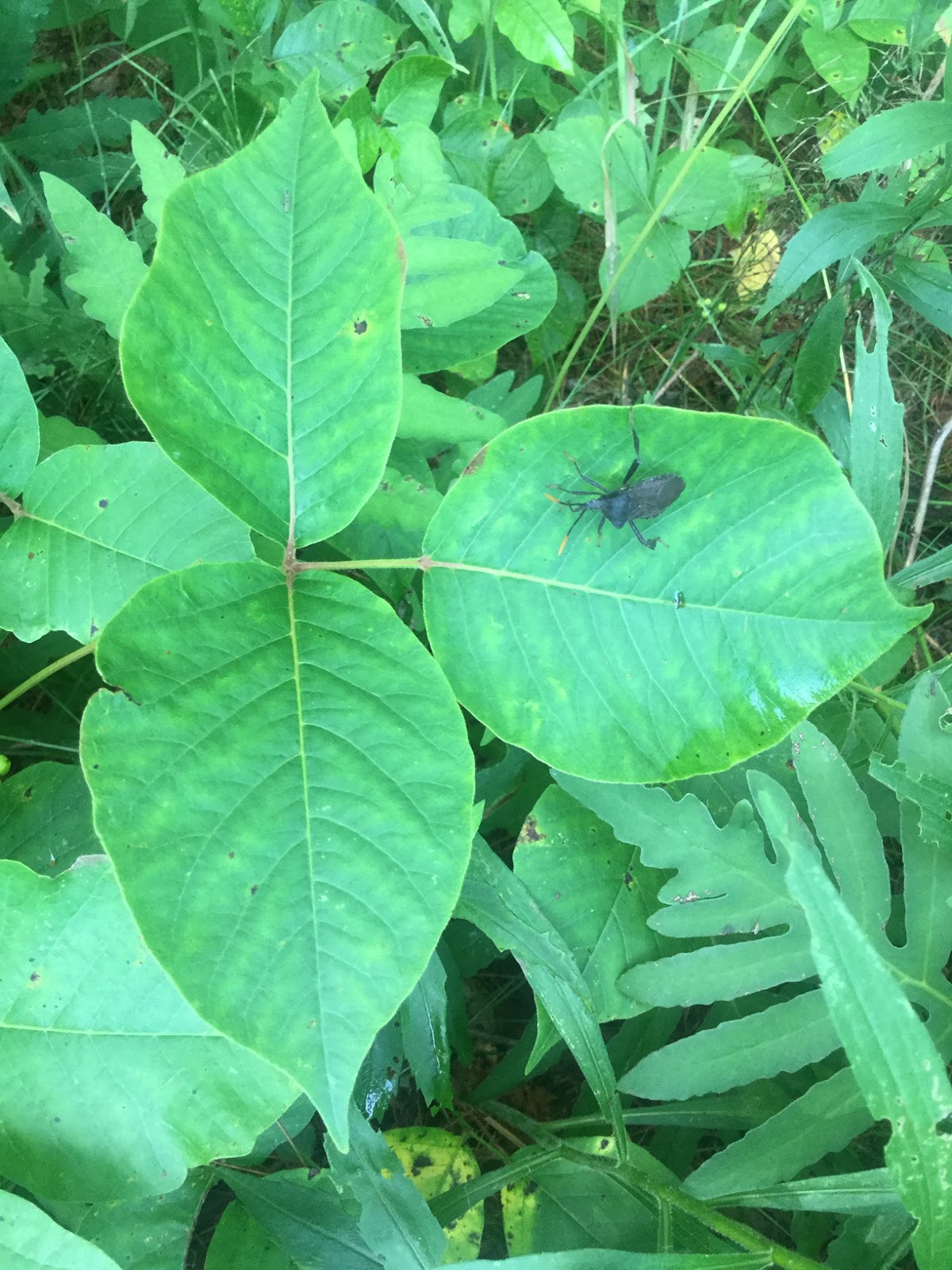
Forging a search image requires spending time looking closely (or I guess just subconsciously assimilating small bits of information over long periods of time works too as I don't ever remember learning to identify dandelion or pigeons or Katy Perry, but here I am capable of recognizing her almost instantly on a poster at Staples). As much as this can work, looking closely is more fun, more transferable, and more interesting. So, looking closely at poison ivy might reveal:
Stem
- A woody stem
- Each aerial stem typically has only 1-2 leaves emerging from it
- Alternate branched leaves
- Poison ivy that has taken to vining, at least in our region, is very uncommon
- When it does vine it uses aerial/adventitious roots to attach to tree (not tendrils, spiraling, or hooks)
Leaves
- The 3 leaves are actually 3 leaflets that together form one leaf.
- Smooth (not waxy or hairy)
- Leaves often show signs of damage from leaf miners
- Form a T-shape, with two on side having short petioles (leaf attachments) than the middle leaflet
- Side leaflets are asymmetrical, middle one is bilaterally symmetrical
- Two side leaflets often look like they're given a thumbs down
Flowers/fruits
- The fruits are like little whitish yellow pumpkins and readily pop off the stem
- They're often hidden beneath the leaves so difficult to find
- I've observed deer and catbirds eating them
Roots
- Reproduce mostly via runners (I've hand pulled poison ivy and if you get a runner you can pull up a few feet of horizontal roots!!)
- Roots are dark brown and around an 1/8"-1/4" in diameter at most.
Wednesday, April 15, 2015
Dichotomous key (VII.d) - The world of internodes cont'd (Adornment)
Adornment - thorny parts
A twig at its most basic form, is rather helpless against predators. Fortunately, trees do not leave them unaided. For example, sap can contain a range of chemical defenses (like the toxic orange sap of staghorn sumac) - this is particularly prominent later in spring when the sap gets, as they say in the sugaring world, buddy; I've written about that previously. Many plants, however, have figured out clever solutions by remolding different parts to serve a more spiky purpose; we only have a scant few trees in our area that have these spikes along their stems - though there are a number of delightfully delicious plants that have thorns (e.g. raspberry, blackberry, roses). These sharp projections derive from three different parts of the plant, the stem, leaves, or epidermis. Also good to remember that the terms below are botanical terms and are vernacularly often used interchangeably.
Spines are projections that form from the stem of the tree, arising from buds. In buckthorn, as shown above, they form at the tips of branches, or rather these spines are the tips of the branch. Hawthorn has very prevalent spines, as do honey locust and osage orange.
.JPG)
Thorns are modified stipules or leaves. The sharp projects on barberry and black locust, for example, are thorns. Above are the paired thorns of black locust, or pointed ears of Marrowzodufia Blugly the Dwarf, as you'll remember from my posting on bud scars.
Prickles derive from the epidermis and are not vascularized (hence the can be popped off quite easily). Roses, raspberries, and blackberries all have prickles. Tracing the stem of a blackberry, rose, or raspberry, it is easy to find a number of scars dotting the stem from where thorns have fallen (or been ripped) off.
 |
| Chickadee flies from buckthorn branch |
Thorns are modified stipules or leaves. The sharp projects on barberry and black locust, for example, are thorns. Above are the paired thorns of black locust, or pointed ears of Marrowzodufia Blugly the Dwarf, as you'll remember from my posting on bud scars.
 |
| Multi-flora rose thorn |
 |
| Blackberry thorn with a scar just above it from where another thorn fell off |
 |
| Tendril anchoring a grape vine to another twig. |
.JPG) |
| Showing adhesive pads on the ends of Virginia creeper |
 |
| Zoomed in view of a sharp and grippy bud of a bittersweet vine |
 |
| Bittersweet climbing a sugar maple sapling |
 |
| Tumurous growth of a sugar maple in response to a bittersweet vine |
.JPG) |
| Poison ivy vine attached to white pine trunk. Image is from August 2012 |
Thursday, May 16, 2013
Poison ivy, yet again

Last year in my post I wrote about eating the young leaflets as they got bigger and bigger. This April I got a little rash on my wrist (same spot as 2 years ago) and so I decided to try the treatment again. I started as the leaves were first bursting open 2 weeks ago. Each day for a week I ate a tiny leaflet (progressively bigger, starting with a piece about half the size of my pinky nail). I then moved to about once every other day. Plants are less potent when they're young (why you harvest medicinals later on in their life cycles when they can put more energy into their chemical defenses). So as I developed a defense to the urutiol by ingesting the plant, the dosage was getting more and more concentrated as the leaves get older. It's probably too late to start this year if you're interested in this treatment, but maybe next year. And some people have much much worse reactions than I do so I would strongly suggest doing lots of your own research on folk remedies and this type of tolerance-development before trying on your own. You run a risk of having a severe systemic reaction.
.JPG)
Tuesday, August 28, 2012
Poison ivy
Yesterday I was out with my UVM class, Natural History of Centennial Woods, and we were taking a closer look at poison ivy (Toxicodendron radicans). I'm not a big fan of the "leaves of three let it be" mantra as it prevents people from actually looking at the plant. Besides, strawberries have 3 leaves, as do boxelder, clovers, some Virginia creeper, sarsaparilla, and heaps of other delicious and beautiful plants.
To avoid confusion and cement an understanding of what poison ivy looks like, we created a list of features that would help us distinguish it from other plants. Here are some of the ones I can remember:
- Woody stem
- Three leaves
- Often has toothed edges to leaflets, rarely smooth (or entire)
- Fades to a dull yellow
- Vines have "hairs" on them (see image below)
- Middle leaflet has longer petiole (what attaches leaflet to stem) than two side leaflets
- Middle leaflet symmetrical, lateral ones asymmetrical
- Two leaflets on side look like they're giving the thumbs down

Ecological notes: Also of note on the poison ivy leaves were an abundance of poison ivy leafminers (Cameraria guttifinitella) that appear to be eating the upper layer of cells on the leaves. A couple years ago I watched a catbird eat the berries from poison ivy with great relish. I've seen rabbits nibble leaves, and apparently plenty of other animals will eat the plant and be unaffected by urushiol, the toxic oil in the leaves, stem, and buds that cause us such great irritation. So just because you see an animal eat something doesn't mean you can (particularly don't try and learn which mushrooms to eat by watching red squirrels).
Where: Centennial Woods, and any moderately rich, well-drained but moist soil near you.
Monday, May 14, 2012
Jewelweed & Poison Ivy
.JPG "Poison ivy leaflets emerging, note: woody stem")
.JPG "Poison ivy has woody stems")
An old timey journal says that anything alkaline (or basic) will temporarily alleviate symptoms but does not grant long-term immunity to poison ivy (Dr WF Dieffenbach's "Treatment of Ivy Poisoning" in Southern California Practitioner v.29). The author describes his experience developing a strong adverse response to poison ivy, finding out about auto-lacto therapy (drinking milk of an animal that had grazed on the toxin), and testing the treatment with success. He fed a cow grass and poison ivy then consumed a pint a day for two days. That year he developed no further rashes. In following years he developed a rash again, indicating that immunity is not permanent and follow-up treatments are required. Admittedly the article is quaint in its anecdotalness (it was published in 1917), but warrants a closer look at treatments for ivy poisoning. **It is appropriate to note here that the plural of anecdote is not data. Also pertinent is that I'm not an apothecary, healer, or medical professional and I only recommend doing this after doing your own research/asking the plant itself.
.JPG "Jewelweed showing its paired cotyledons and emergent secondary leaves") Ecological notes: Centennial Woods is filled with poison ivy, as are most places that are wet, but well drained, and rich, but not excessively so. As is convenient with mugwort growing near poison oak out west (mugwort can be used as a poultice to treat the itchiness caused by urushiol in poison oak), here in New England jewelweed (Impatiens capensis and I. pallida) almost always grows near poison ivy (but the reverse is not true as poison ivy is much less common).
Ecological notes: Centennial Woods is filled with poison ivy, as are most places that are wet, but well drained, and rich, but not excessively so. As is convenient with mugwort growing near poison oak out west (mugwort can be used as a poultice to treat the itchiness caused by urushiol in poison oak), here in New England jewelweed (Impatiens capensis and I. pallida) almost always grows near poison ivy (but the reverse is not true as poison ivy is much less common).Where: The photos are from Centennial Woods. Below are a couple of look-alikes, at least in the early stages. On the left is sarsaparilla, which has 3-5 leaflets, doesn't have a woody stem, and splits into three branchlets. On the right Virginia creeper (Parthenocissus quinquefolia), which has suction like discs on the ends of their tendrils and five, not three leaflets.
.JPG)
.JPG "Virginia creeper is a look alike, but has five leaflets and has suction disks at end of tendrils")
Other notes: Poison ivy is in the same genus as other toxic plants like Poison sumac (T. vernix), poison oak (T. diversiloba out west and T. pubescens out east). The genus is in the Cashew family, Anacardiaceae, which also includes staghorn sumac (delicious) and, not surprisingly, cashews. Members of Toxicodendron are occasionally placed in Rhus, the same genus as staghorn sumac.
Subscribe to:
Posts (Atom)