Showing posts with label moon. Show all posts

Monday, January 28, 2013

Full moon


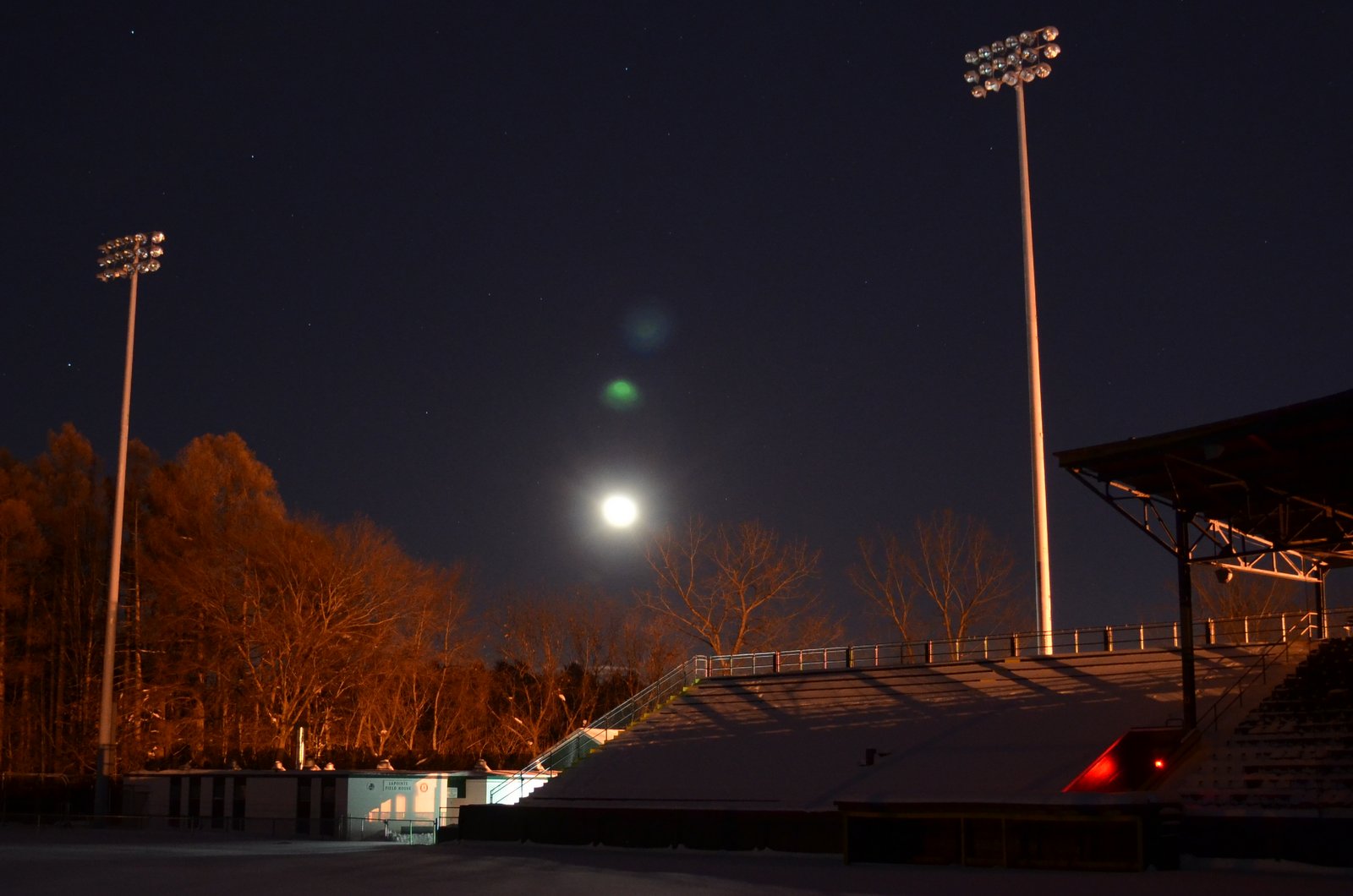
I wanted to post a quick note about the moon since it was out in such dramatic form tonight, and I was feeling really grateful for all the cold weather that seems to have helped cleared the air, and made everything feel a little more alive in a weird way.

I know the full moon was Saturday night, but it definitely seemed fuller tonight. I had the great fortune of driving due west from about 6pm - 7pm on my way back from Troy and got to watch the moon rise up over the southern part of the lake. In that hour the moon shifted from the deep yellow of a wolf's eye to a striking - almost blinding - white, much like the morning reds, pinks, and oranges giving way to a clear, light blue in the middle of the day (boring explanation: the color shift has to do with the amount of atmosphere between the viewer and the moon - blue gets absorbed first, but giving enough atmosphere longer wavelengths, like red, get absorbed and we are able to see them since they overshadow the blues).  

You can notice the slightest wavy part of the top of the moon, which is actually a shadow, revealing the ever-so-slightest crescent carved out of the moon. The chunk was on the trailing end of the moon's path in the sky, indicating that the moon is waning. And, the photo below is a weird phenomenon -that offset green mirage of the moon - I've noticed a couple of times while photographing full moons.


Thursday, January 10, 2013

The Moon (part III)

Wednesday - Crosses light post around 11:50pm
Thursday - Crosses light post around 12:40am 
Here's the second thing I learned from photographing the moon last week, and this is visible in this set of photos here, is that the altitude of the moon in the sky changes when the moon as at the same bearing (direction on the compass) on each of the nights. That is, the arc that the moon follows across the sky each night is different. At this point in the lunar cycle, with each successive night the moon travels a slightly lower arc across the sky. I haven't the foggiest why this is, but it indicates that the moon's orbit around the earth isn't fixed. So the sun does this on an annual cycle (sun is lowest in the sky at Winter Solstice, highest at Summer Solstice), but the moon appears to do this on a lunar cycle. And why doesn't the moon just slip out of earth's gravitational field if its rotational axis wobbles around so much? And why does the moon always face us from the same direction?

Saturday, January 5, 2013

The moon (Part II)

What: As a follow up to my last post, I wanted to post about why the moon cycles at all from new to quarter to full and back to new in 28 days. To get a sense of this myself I went out to Centennial Field the past three nights at 10pm, 11pm, and 12am to take photos. Below are the shots from 11pm on Tuesday, Wednesday, and Thursday nights. In New England, about half the days are good for viewing stars, so I was happy to get at least some shots of the moon between cloud breaks (Wednesday was easily the best, but it was super cold, last night the moon wasn't clear until the clouds broke around 12:20am).

Taken on Tuesday night at 11:03pm
Taken on Wednesday night at 10:58pm
Taken on Thursday at 11:00pm, moon hadn't risen yet
Two things come up in this. Apart from the lighting being totally different in each photo, note the different positions of the moon. This is true in two ways. First, the moon appears at a different bearing (direction on a compass) in each photo even though they were all taken within 5 minutes of each other on each night. Put another way, it takes a little longer than 24 hours for the moon to rotate a full 360o around the earth.

I remember that my calculations over a long period of time in Santa Barbara indicated that the time difference for the moon to get to the same bearing (not height, or altitude, but compass direction) in the sky was offset by about 52 minutes later each night. So each night the moon rises about 52 minutes later than the previous night.

For the moon to return to the same bearing in the sky at the same time of day/night, which is the same as completing a full revolution around the earth, it would take 24 hours (a full cycle) / 52 minutes, or approximately 28 days. 

Thursday, January 3, 2013

The moon


What: I've been trying to pay a bit more attention to the moon the past few months, and the last couple of nights I've returned to a project I started when I lived out under the stars in Santa Barbara. Astronomy completely perplexed me and I couldn't really understand anything I was reading about the moon so I decided to put the books down and just do my own research.

Here's what I've learned so far from observing the moon:
  1. The moon doesn't rotate along its own axis. Every night, regardless of phase, time of year, etc. the moon is always facing us with that same sonorous "face".
  2. It takes the moon longer to rotate around the earth than it takes the earth to spin in a full circle.
  3. It takes a little less than 53 minutes longer to reach the same point in the sky on each successive day (53 minutes goes into 24 hours about 28 times - each day the moon is 53 minutes further behind, after 28 days it has made a complete revolution)
  4. As a result the moon is in a different position relative to the sun by the time we can see it each night, resulting in a different "phase" of moon (I'll post a crummy drawing in a couple of days that will show this)
  5. If the section of moon that's lit up is on the west side the moon is waning (getting smaller), if it's on the east then it's waxing (getting bigger).
  6. On a full moon, the moon rises just as the sun sets, and sets just as the sun is rising
Photo I took of the full moon in October, 2012, compare with
the image of the waning gibbous moon, above right
I may be wrong on some of this so feel free to fact check me (just no using books). Nate (aka Gull, aka woodsmen drums smith) and I were just talking about the difference between smartphone apps like Moon Phase or websites like the moonrise finder and using primary experience to find things out. I think it's in the moments between finding the answers that are so important, like hearing the steel girders of the baseball stadium awning creak and groan and rumble like the belly of a ship as the temperature dropped (just as I could watch the moon move, I could almost feel the temperature drop from 2oF @ 7pm to -5oF at midnight). Using an app I would have missed the shooting stars blazing streaks across the sky. Perhaps in the end the information gleaned is the same, but the process is entirely different and I greatly prefer the long road, which is always home to many many divergent paths.

Other notes: Gibbous comes from the Old English "hump" or "hunch" and was used to describe hunchbacks before it was used to describe the moon.

Tuesday, September 4, 2012

The eerie glow of night


What: A beautiful respite from life brought me out to say hello to the moon. There's something about looking up that takes the breath away, as though the simple shift in perspective, lifting the gaze from one's feet up past the heart and into the heavens, shakes the body in a way that makes one's autonomous system, the unthinking mechanism that keep us alive, just shut down. For me this comes out as a small gasp when delighted by the gift of suddenly seeing the warm gaze of the sonorous moon. The sight is an ancient reminder of every moon that has cycled around the earth since there was a moon to rotate around the earth. It made me feel delightfully small, delightfully free.


The moon is waning from our blue moon (the second full moon within a calendar month). And I found particular fondness for the moon's waning bodice, which hummed a vibration softer and warmer than the cool glow of the electric lights presiding over the Lake Monster's game. With a long shadow casting over my shoulder I snapped a few shots, impressed at the brightness of the moon, its details washed out in each photograph. Looking at the photos, I'm fascinated and intrigued by the patterns of distortion that come out, from the lens flares to the double image of the moon (above).


Where: Overlooking Centennial Field on the last games of the year.

Sunday, May 6, 2012

Super moon!!

Super moon (full moon at perigee)
What: Full moon last night was just incredible.

Ecological notes: The moon has an eliptical orbit and last night it was the closest that it will be this year (called the perigee). The super moon appears 30% brighter than normal and about 12% larger than normal. Rising over the Greens, the swollen moon dominated the horizon. The light altocumulus clouds were glowing and it was actually hard to take a picture and pull any detail out of the moon because it was so bright.

Where: I took the time lapse photos from my house in Burlington.

Other notes: There will be a partial solar eclipse on the new moon (May 20th).

Saturday, April 7, 2012

Full Moon


What: A beautiful full moon arcing over the sky at Shelburne Farms. The first two shots show moon rise (around 10pm). The thin layering of altocumulus clouds produced the perfect setting for a beautiful irridescent corona. Coronas form around the sun as well, but the sun's bright light often obscures the optical light show. They are formed when light reflected off the moon is diffracted - when light bends around an object, which is different from refraction where light actually changes direction and speed - by individual water droplets. Thus the size of the aureole (the brighter inner white part) depends on the size of particles the light is bending around; the smaller the particles the larger the radius. The third image shows the moonset (around 6:15am).

Ecological notes: It was a beautiful night. We've had weather consistently around 40-50 during the day and 30 at night. The clouds have been light and beautiful the past couple of nights with brief glimpses of moonlight dancing between them.

Other notes: On Thursday, a friend's dad, Fred Homer, showed me the shells of a box turtle and a wood turtle. I read in a Joseph Bruchac book that turtles have 13 plates (called scutes) in the middle of the top of their shell (called a carapace, the bottom half is called a plastron). The central and coastal scutes are bordered by the marginal scutes. From another source, I remember reading that there are 28 marginal scutes. I only counted 25 around the edge and found that this number is far more plastic than the 13 central scutes. Bruchac, and many others, connect the 13 scutes to the 13 moons in a year. It would have been convenient to have 28 marginal scutes to connect to the 28 days in a lunar cycle. But alas, most of our turtles have 25 marginal scutes (only mud and musk turtles have 23).