Showing posts with label winter. Show all posts

Tuesday, March 10, 2015

Dichotomous key (I) - Branch pattern (phyllotaxis)

Opposite apical buds on winged euonymous (Euonymous alatus)

Dichotomous: Dikho (Greek: two, apart) + -tomia (Greek: cutting)

Given my familiarity with the gross anatomical features of twigs, I was ready to dive into identification by learning the specifics. It would be in my ability to discern variation in the different features that would allow me to use a dichotomous key and identify the twig of concern. A good dichotomous key is indeed a rare thing. Many field guides (most tree ID books) lack them because they often require highly technical language, making them difficult for neophytes (pun intended) to use. But they are incredibly useful as they force the observer to look and look again. Making good dichotomous keys (for anything) requires the following:
  1. Finding categories that you can use to lump the things you're studying into the largest groups possible. These categories will have to be binary. For humans, you might start with something like gender, or eye color. You wouldn't start with obscure characteristics, like has four fingers since this would give you two very uneven sized groups.
  2. Avoid relative characteristics (like big, frail, etc.) and be specific with numbers where possible
  3. Come up with characteristics that have only two answers. Essentially, you're creating two groups repeatedly until there's only one item in each group. So blond and not blond, male and not male
  4. Start with easy to observe characteristics. Things get harder to split into groups the more specific you get, so start with things that are simply and easily observed
Remember too that a dichotomous key is only as good as the person who made it. These are some of the potential hazards of a dichotomous key:
  1. It relies on a characteristic not present on your specimen (mature bark deeply furrowed when you only have a sapling)
  2. It uses something clear to the author not clear to the user (e.g. too technical of language)
  3. Lack of clear contrast in characteristics (flowers red vs flowers pink)
  4. Uses relative or subjective characteristics (e.g. plants tall)
  5. One group is a clump of multiple characteristics (flowers yellow vs flowers white, red, or absent)
  6. The plant you have is not in the key! Plant ranges have changed over the years and an old manual may say your plant only grows south of Massachusetts. 
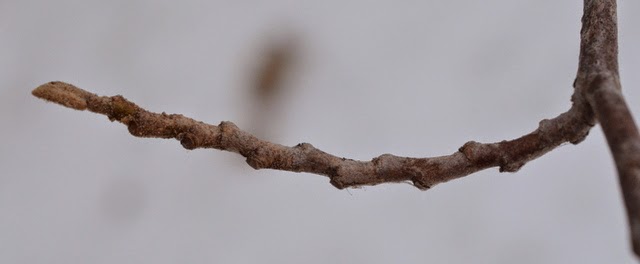
Rather than rewrite a dichotomous key, I wanted to focus in on the attributes of some of the key features used to identify plants by their twigs. A common way to start with our trees is evergreens vs deciduous trees but I skipped that since for now I'm just focusing on hardwoods (synonymous with deciduous and broad-leafed). The next most common way of lumping them is to look at branching patterns. For our broad-leaved trees, branches can be arranged in one of four different ways.

Witch-hazel (Hamamelis virginiana) bud showing exagerrated zig-zag of alternate branching

Alternate
Each node - part of the stem where the buds originate/leaves attach (the internode, the space between two nodes, is nearly absent on spur branches) - only contains one lateral bud.

Opposite branching in white ash (Fraxinus americana)

Opposite
Each node contains a pair of lateral buds.


Sub-opposite branching in glossy buckthorn (Frangula alnifolia),
 buds are paired, but not directly opposite one another

Sub-opposite 
Each node contains a pair of buds, though they are not directly opposite one another on the stem. This often will occur on rapid growth of plants that are typically opposite. 

Catalpa (Catalpa sp.) branch showing two shoots and leaf scar coming out from same node

Whorled
Each node contains three or more buds. The least common branching pattern. We only have two species of hardwood trees/shrubs in Vermont with whorled branches. Catalpa and buttonbush. 

Saturday, February 15, 2014

Plastic snow

Sastrugi - the sharp features of a windswept snow surface bordering fractured plates of ice in middle of photo.

When I was younger, I had one word to refer to all that white stuff in winter: snow. As I got older and had more experiences with it, particularly through snowboarding, I realized that not all snow is created equal. Snow taxonomy has a history much older than winter ecologists, and much of the rich language found in cold climates to describe snow has been adapted by winter ecologists (like the Russian sastrugi - above, or Innuit qali - below).

Snow can be grouped into three categories:
  1. Falling snow
  2. Snow on the ground
  3. Surface-generated ice features (like ice needles being pushed up from the ground on wet trails, hoar frost, icicles seeping out of cracks in bedrock)

Qali describes snow hanging from trees (like in the image above). Because our snow the other night fell in a frenzy of blustery winds, there wasn't a whole lot of qali left on the trees. Sintering is a natural process where snowflake crystals fuse together. Sintering can happen due to pressure (like stepping on the snow pack) or temperature (melt-freeze together). Because the snow crystals actually bond together, qali will act as a liquid moving in slow motion. Snakes, like in the image above, are common features in northern woods after a good snow storm. We observed a spot today where the sintered snow had bent down around the rock, creating a perfect overhang for a weasel to pop in and out of while hunting.

Wednesday, February 12, 2014

Getting closer...


What: Sam and went out to the lake yesterday to check in on the progress of the lake freezing over. Boy oh boy did it look frozen all the way across! With the continued cold weather the lake just might be crossable this winter! This would be the first time since 2007. Lake Champlain won't be the only large lake to freeze across. Looks like Superior is on the same trajectory (news story here)!!!


In the afternoon there were people playing hockey out on the ice (specks in bottom left of above photo). Later that evening Jon and I ran out to the light house and followed snowmobile trails. So at least as fall as the break wall, the ice is solidly frozen.

Tuesday, January 28, 2014

Icicles abound!


What: Winter always makes me remember how I forget about the winter when it's summer. It's hard reconciling the stunted, gnarled growth of the silver maples and white cedars that grow along the edge while sitting on the shore, my feet gently washed by the warm waters lapping up under a lazy summer sun.

But being out during the winter, when spray whipped against the low hanging leaves and branches and supersatured "foggy" air right above the lake freezes into tight icicles, gives clue as to the real limiting factors for planst growing next to the edge. The sacrifice for all that sun is a 2" rind of ice that snaps branches and scouring icy winds that peel away bark.


Icicles were also abundant on the underside of overhangs. The icicles below had formed on a rock that was about 10' off the shore. I assume they formed as snow melted from above and froze as it dripped off the rock (and out of the sun). Supersaturated air condensed onto the little icicles forming the weird lichen-like flakes clinging to the sides (a secondary feature).


Also of note was the stalagtites on the underbelly of the overthrust. The chunky yellowish rock is the much older Dunham dolostone perched atop the scraggly charcoal-colored Iberville Shale. Both weather pretty easily, but the dolostone, a lightly metamorphosed and then aged limestone, is filled with lots of cracks. Because it's a limestone (made of calcium carbonates), it weathers rather easily under the acidity of rain (if you drop hydrochloric acid on a freshly cut surface it will fizz as the acid reacts with calcium carbonate and releases carbon dioxide). In this section, the deep groves in the rock have been exaggerated by acidity over time and the icicles are forming under one of these fissures.


Along the edge of the cliffs the fissures become breaking points where larger rocks fracture off the cliff and plunge into the water. A dramatic event, to be sure, as the more crumbly shale beneath erodes faster, so the dolostone plummets rather than roles to its resting place in the lake. The picture also shows pretty straight geometric lines. The fractures are older than the erosion by acidity, which just expedites the fracturing process. And in places more distant from the cliffes, the fissures form small to occasionally large caverns, called karst topography. Many of the caves in Vermont are located in these calcium-rich, or calcareous, bedrocks. 


Thursday, January 23, 2014

Wet vs dry snow


I'll be posting over the next week about some of the snow/ice phenomena that I observed today while walking around Rock Point. But before I go into that, I wanted to say a bit about what I've been thinking about since last week's snow fall. The first snow fall (on the 16th) fell during the warmer spell. You may have noticed giant snowflakes, which were actually just conglomerates falling together. My suspicion was that the white orbs in the center of each flake (seen in the photo below) are melted snowflakes that fused together with flakes that hadn't yet melted as well as had begun again the process of snowflake formation.


So what happens to snow once it falls? After snow falls on the ground it can either remain unchanged, which is never permanent, or it undergoes metamorphosis. Metamorphosis can happen in a few ways:

  1. constructive: like the formation of depth hoar - aka sugar snow, which forms the ball bearings on which avalanches often form. This occurs when there's a sharp contrast or gradient in temperature from the surface of the snow pack to the bottom. Temperature gradient creates a gradient in vapor pressure and water gets passed from warmer areas (high vapor pressure), near the ground, to colder areas (lower vapor pressure), near the surface
  2. destructive: (the "melting" of a snowflake to a little knobby snowball on slightly reminescent of the flakes original shape). Water vapor is released from the points of a snow flakes and is passed to the pits of the flake (near the base). This is a very complex process and I suggest Jim Halfpenny's Winter: An Ecological Handbook
  3. firnificationmelt-freeze temperature swings or applying pressure (like stepping on snow or another snow storm putting weight on top of older snow) can fuse snow crystals together. The first process can create dangerously slick crusts on the surface of the snowpack, which coincidentally protects small tunneling mammals underneath; the second force is what gives quinzhees their solid, insulating structure.
  4. wind: wind can break snow flakes under mechanical force into smaller pieces. 

Wednesday, January 22, 2014

More ice from the causeway

I was captivated by the way ice was flowing while out at the Causeway. I wanted each clip to run indefinitely, to be lulled by the lake's monotonous drone of wind and water. Nothing dramatic, just the water's quiet dramatization of winter's cold.


Monday, January 20, 2014

Cold Cold Colchester Causeway


What: The Jons, Christin, and I headed out to Colchester to walk the Causeway and see what it would like like with all the snow. I was away for most of the cold weather in December and early January and wanted to see what chance the lake might have of freezing over this year. According to NOAA, the water temperature up around Colchester Point is 34degrees, and since freeze overs don't usually occur until the end of January or beginning of February, I'd say it's looking close.


Jon Bond, our intrepid explorer, testing the resilience of the ice

The covering ice Niquette and Mallet's Bay was stunning. With low visibility it seemed like an endless artic desert. The ice was in stark contrast to the other side of the trail, which was almost entirely open. The Causeway, which forms the barrier between Lake Champlain and Niquette and Mallet's Bay, is an old railroad bed constructed 1899 to open up markets in the Great Lakes. The "fill" is actually large chunks of marble, which supports a few limestone loving trees, like basswood and white cedar. 


Above shows a the clear difference in habitat between the more exposed lake and the more sheltered bays. Wind and surface turbulence of the water will draw up relatively warmer water from the depths of the lake buffering the lake from freeze. Water movement can also prevent freezing. Lower winds combined with shallowers depths allowed for the bays to freeze of first. The tongue of unfrozen water on the right side of the above image corresponds to where a bridge creates a break in the buffer and has allowed that stretch to remain unfrozen.


With another polar vortex in full swing and hopefully another couple weeks of subfreezing temperatures, we just might get a freeze over and I just might get to run across the lake. I posted last year about lake freeze over events (it hasn't froze over at the widest part - 9.5 miles from Burlington Bay to Corlaer Bay - in 32 of the past 54 years; and 6 of the last 6 years - since I moved here - it hasn't frozen over).


In the distance there was an oddly geometric island (in the photo above, it's just to the left of the island, but in the distance beyond the ice-locked boat). Turns out to be a (see this photo for what it looks like on a very distant beautiful summer day). 

Friday, March 15, 2013

Possum and more feet

Right front
Left rear
What: Brooke alerted me to a roadkill opossum (Didelphis virginiana) on East Ave the other day that I picked up. I like to poke fun at these bizarre critters, since they're one of the most retched creatures we have. They amble in a dopey, almost drunken way, are often drooling, and are frequently the victims of frostbite, which reeks havoc on their ears and tails. I once watched a possum lick my fence for about 15 minutes. I got close enough to touch it, but not close enough to have any idea of what it was licking. They're certainly a different kind of beast.

Frost bite on ear
Fun facts about the Virginia Opossum:
  • Possums have a super short life span (a 2 year old possum is ancient)
  • They have 50 teeth (dental formula: 5134/4134)
  • Possums don't "play" dead but actually become catatonic. It's an involuntary response, the crescendo of which is the expulsion of a foul smelling liquid from their scent glands. I'd assume that this deters any predator from wanting anything to do with eating the animal (it also starts drooling, will urinate and defecate as well as lower its temperature and heart rate). 
  • They only have awn hair, which explains the raggedy look of their coat (somewhere between the insulative down hairs and the coloration hairs we collectively call the pelt and individually the guard hairs)
  • Only the females have pouches (and they're super small)
  • Possums frequently get frostbite here in Vermont. They're at the northern most extent of their range and have naked tails/ears. Like cardinals, they have moved their range north following urban centers of people.
  • Males have a scent gland on the chest that gives the fur in that spot a gross yellow color
  • They are not winter mammals, and can lose almost half their body weight during the winter
  • Sperm is paired and doesn't swim straight if single
  • They're essentially immune to snake bites
  • They're total scavengers (which might be why I have such an affinity for them) and apparently have a rapacious appetite for calcium so frequently eat road kill skeletons
  • They supposedly even will kill rats, but mostly they scavenger for invertebrates and carrion
  • They have a very very slow metabolism (unlike shrews) and move much slower than most animals their size
Frost bite on tail

Ecological notes: The frostbite they frequently get doesn't matter all that much, nor is their much selective pressure pushing them to adapt to the winter since they live such short live (rarely living more than one full winter). They are continually pushing their range northward. Young possums can hang by their tails, but adults can't.

Where: East Ave

Other notes: Opossum comes from the Algonquian word "opassum" which translates roughly to "white animal". The word was first used in 1608 by Capt. John Smith. His description of "possums" (the 'o' was dropped in writings as early as 1613), is simple and alludes to the oddball-ness of the creature: "An Opassom hath an head like a Swine, and a taile like a Rat, and is of the bignes of a Cat. Under her belly she hath a bagge, wherein shee lodgeth, carrieth, and sucketh her young."

Other posts with photos of animal feet in them:


Wednesday, February 20, 2013

At the end of every trail...


What: Brian came downstairs yipping about a red fox in the parking lot. A minute later Meryl came down equally excited. We threw on our shoes and headed out into the beautiful snow. We picked up the tracks circling along the edge of cedars then along the powerline substation by UVM Facilities office and Centennial Field. In the photo below the fox demonstrates a near perfect direct register trot. In this gait the animal's rear foot lands exactly where the front foot landed. The 3rd, 5th, and 7th prints appear wider where the animal slips from the direct register just slightly. The front foot, which is larger (as with all canines) and appears under the imprint of the rear foot, is offset to the right, where the fox was probably looking to the right (up the road to East Ave).


We came to a very very small crack in the fence that it had scooted under. Weirdest thing is to think how that little opening got there, as it seemed deliberate. Could the foxes have worked up the fence over time? It'd be tough for even a human to bend that fence. The fence is other wise in perfect shape and it's on the side that doesn't have any traffic so it's hard to imagine it accidentally getting formed. Regardless, it makes for a nice escape hatch (as when being pursued by a pair of humans).


On the east end of the substation, there's another gap in the fence that the fox slithered through before making its way down the rocks towards the dumpster. See if you can spot the fox in the image below. Brian and I watched the fox for a bit tugging away at the ground before slowly stalking up on it. 


As we got closer, it looked like it was trying to get under the plow. When we got about 35' away we scared the fox off and were able to investigate what it was investigating. We found a dead squirrel tangled in a pile of trash (smelled really really bad). The fox ran around the fence and hid under the building you can see in the above image.


Where: UVM Facilities/Centennial Field

Other notes: As we approached another fox of equal size got spooked and headed over to the south where the mulch piles are. The weirdest thing was that the fox was white. Or rather, it seemed like a darker colored fox that had its coat covered in snow. Brian and I were both covered in snow after being out about 30 minutes, so not unlikely, but still seemed weird - albino foxes in CW?

Monday, February 18, 2013

Snake mountain and lake closings (freeze overs)


What: I hiked up Snake Mountain with Jon and his family yesterday. Looking out at the southern end of Lake Champlain, I was surprised by how the sharp line at the edge of the ice was. The ice seemed to be corralled into the southern bay, perhaps by the harsh northerly wind. The freezing point I think was between Potash Bay in Addison, VT and Mullen Bay near Westport, NY.

The image to the right shows data collected on the lake between 1816. Rectangles on the left side, colored in red, indicate years in which the lake did not freeze over completely at the widest point (from Burlington Bay across the lake about 9 miles to Corlaer Bay; 6 miles if you don't include the 2 bays).


In total, since data collection began, the lake has not frozen over 38 times in the past 197 years. 32 of these are in the last 54 years! While it might be convenient to readily assume that climate change is the culprit, there might be some confounding factors that have also changed over the past 197 years. Things that lower the freezing point of water could include increased:
  • Turbidity (suspended solids absorb more heat from sunlight)
  • Wind
  • Turbulence (like flow in a river)
  • Concentrations of salt, alcohol or any other substance that has a lower freezing point than water
I don't know for sure if these have any bearing on the fact that the lake is consistently less likely to freeze over, but they are likely a part of the story. I found an article from Feb 15, 1993 in the Daily Gazette about Lake Champlain closing dates (when it freezes over completely). The article states:
"Whether the lake freezes over or not has no effect on the fish and other creatues that live there, said George LaBar, a UVM fisheries biologist. 'The bays are always going to be frozen, those shallow areas are going to freeze over,' and the fish who live in those bays are used to that, he said. A frozen lake doesn't affect teh overall temperature of the lake water, he said. Winters with less ice cover might encourage fish to spawn earlier, he said, which allows the young fish to grow larger."
I really doubt that the lake not freezing over has no effect. I think it probably means something pretty significant for some things and not so much for others. Complex system with complex feedback loops.

Saturday, February 16, 2013

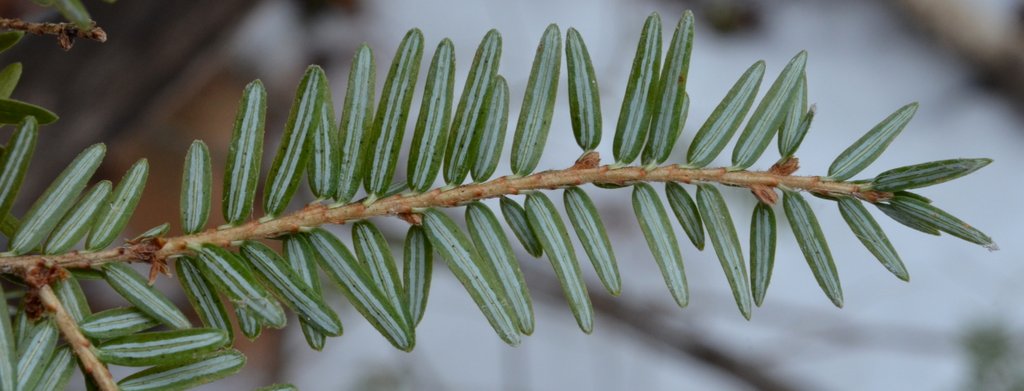
How hemlocks breathe


What: I used to describe the underside of a hemlock needle as being akin to an old classic longboard surfboard. It wasn't until a few years ago that I actually wondered what those little white lines on the underside of a hemlock needle actually were.


Ecological notes: Those two white lines are actually a bunch of little white dots, which are actually the stomata (the mouths, or sites of gas exchange, in leaves).

Because conifers weather out the winter with their needles still on the branches, they have to compete with harsh winter winds for water. They effectively have a water input of zero. With the ground frozen, the tree can't replace any of the water it might lose to transpiration (basically evaporation of water out of any openings in a leaf). Transpiration increases with wind that would carry water vapor away (much like how you can tell wind direction by licking your finger and holding it up; it feels cool on the windy side because the water is evaporating even though it's well below the boiling temperature where you'd expect it to go from a liquid to a gass).

Hemlocks would risk desiccation (severe drying) in the leaves unless it could somehow protect itself from the ways it loses water. It does this in a couple of ways. First, it has a super waxy cuticle. The waxy cuticle prevents transpiration from occurring on the top side of the leaf. Second, it protects the stomata (those openings) from being exposed to the wind by putting them on the underside of the leaf and having them in grooves.


Monday, February 11, 2013

Winter Storm Nemo time lapse


What: It didn't turn out nearly as well as I had hoped, but on Thursday night I set out my camera to capture a timelapse of the incoming winter storm Nemo. If you look at the pallet at the bottom of the screen you can see rise in snow as it accumulated. The winds knock off most of the snow from the trees by the second day.


Where: My backyard

Other notes: Meryl pointed out to me that winter storms only recently started being named storms. The Weather Channel, aka weather.com, published a press release explaining their new self-appointed role of winter storm namers. here's an excerpt:

"During the upcoming 2012-13 winter season The Weather Channel will name noteworthy winter storms. Our goal is to better communicate the threat and the timing of the significant impacts that accompany these events. The fact is, a storm with a name is easier to follow, which will mean fewer surprises and more preparation. 

Naming Winter Storms
Hurricanes and tropical storms have been given names since the 1940s. In the late 1800s, tropical systems near Australia were named as well. Weather systems, including winter storms, have been named in Europe since the 1950s.  Important dividends have resulted from attaching names to these storms:
  • Naming a storm raises awareness.
  • Attaching a name makes it much easier to follow a weather system’s progress.
  • A storm with a name takes on a personality all its own, which adds to awareness.
  • In today’s social media world, a name makes it much easier to reference in communication.
  • A named storm is easier to remember and refer to in the future."

Sunday, February 3, 2013

Hemlock, the patient one


What: Even with the leaves off the trees and sounds (particularly I-89) filtering through the woods with reckless abandon, there's still a peacefulness to the movements of the woods in winter. While walking across the Winooski Bridge I admired the slow undulating flaps of a Cooper's hawk above and the odd oscillations of the water bubbling back and forth off the ice as it came to a halt in front of the dam. The hawk flitted gracefully to the west, cut a quiet line through dense air and alighted on a distant smoke stack.

There's an equal grace and peacefulness to the slow bending of a hemlock - what I call the Winter Tree - under the sway of the wind. Among the conifers, hemlock stands out to me as such a delicate and deeply cold tree. The rich green of the foliage feels more like the shadow of a leaf, like the tree was born in winter only to endure summer each year.

The branch above is about 2 3/4" across

Enduring the summer means slooooow growth. I was out harvesting wood for coasters, and I found a giant old hemlock that had come down across Wool Pullery Brook in South Burlington. I cut the branch from the trees in the photos at the top (about 35' from the trunk) right at the base where it came off of the tree (if the tree were still standing the branch would have been about 25' up). Hemlocks are about the most shade tolerant species, and a single hemlock needle can live for up to 40 years (in part because it can deal with as little as 10% light and still photosynthesize enough for the plant to keep it around; for contrast, white pines are far less tolerant of shade and lose about half their needles each year).

I guess I shouldn't have been, but I was surprised at how ancient the branch was given its size. It was too hard to count the rings by eye so I sanded and finished the "cookie", photographed it, then ramped up the contrast. Each arrow represents 10 years of growth. The rings were extremely tight, and there's a distinct boundary between the heartwood and sapwood (sapwood is the lighter section of rings on the outside). The branch was much less resinous farther out, indicating that the distinction was largely due to the tree needing extra support in holding up that branch for 106 years.

Where: Hemlocks grow at extremes - there are hemlock swamps and there are steep rocky hemlock slopes. It can grow in the shadiest of places, less than about 10% light. This tree was growing along Wool Pullery Brook in Centennial Woods.

Wednesday, January 30, 2013

Crow Roost Video

You can subscribe by entering your email in the bar to the right. Thanks! 


What: This is a follow up on the posting from over the weekend. Zac caught a couple of shots of the roost when it was over by the cemetery on Archibald about 3 weeks ago. The rest I took last Friday while hunting them down. On the previous post, I included a map that you can use to see where we were for the different shots.

Ecological notes: The crows are still jumpy in selecting their nightly roosts and it's been hard to keep track of where exactly they are each evening, but they seem to be preferring the Intervale for one of their last staging areas before flying south to their nightly roost. It's an exciting safari everytime I try and follow them in the evenings.

Lots of speculation here, but it seems the main reasons for roosting behavior in crows seem to be:
  • predator avoidance
  • huddling for warmth
  • flirtation (finding mates for the nesting season)
  • storytelling
  • being social
Where: Burlington (and other urban areas)

Tuesday, January 29, 2013

Wonders of the Modern World of Latham Ct


What: Jon and I went for a great walk through Centennial Woods last night - the orange glow of Burlington was bouncing between the low clouds and the fresh blanket of snow, giving the woods an eerie lightness to it. On our way back home we passed by the giant spruce tree in "the extension," which was backlit by an orange glow to the north (right in photo) from the older sodium vapor street lights and the white glow to the south (left) from the new LED street lights on East Ave (something that Chicago's started doing a couple years ago).

Callan and I dubbed the tree one of the wonders of the modern world of Latham Ct. As with some of the other photos I've taken that seem to capture the spirit of the moment, I go back and forth wanting to describe the ecological reasons behind the photo and wanting to pause and inhale the poetics of such profound presence.

Monday, January 28, 2013

Full moon


I wanted to post a quick note about the moon since it was out in such dramatic form tonight, and I was feeling really grateful for all the cold weather that seems to have helped cleared the air, and made everything feel a little more alive in a weird way.

I know the full moon was Saturday night, but it definitely seemed fuller tonight. I had the great fortune of driving due west from about 6pm - 7pm on my way back from Troy and got to watch the moon rise up over the southern part of the lake. In that hour the moon shifted from the deep yellow of a wolf's eye to a striking - almost blinding - white, much like the morning reds, pinks, and oranges giving way to a clear, light blue in the middle of the day (boring explanation: the color shift has to do with the amount of atmosphere between the viewer and the moon - blue gets absorbed first, but giving enough atmosphere longer wavelengths, like red, get absorbed and we are able to see them since they overshadow the blues).  

You can notice the slightest wavy part of the top of the moon, which is actually a shadow, revealing the ever-so-slightest crescent carved out of the moon. The chunk was on the trailing end of the moon's path in the sky, indicating that the moon is waning. And, the photo below is a weird phenomenon -that offset green mirage of the moon - I've noticed a couple of times while photographing full moons.


Sunday, January 27, 2013

Crow Roost


What: Zac and I have been talking a lot about the crows and how they seem to be jumping around a lot from night to night. A couple weeks ago we spotted them at the cemetery on Archibald. Thursday night they were sort of heading that direction so I tried tracking them down. Around 4:30pm on Thursday I watched them flying north from Centennial Woods over the McNeil Plant. Below is a map that shows my route (red) compared to the rough route the crows took.

And I was in Troy, NY for a WFA course this weekend. Saturday night I went for a run as the big full moon was cresting over the hills. It was about 4:45pm or so and I wondered if I might see crows in this neck of the woods flocking to their winter roost. Sure enough I spotted one about 3 minutes into my run flying south over the Hudson River. I followed the crow (which soon disappeared into the flock of hundreds of other crows) for about 3 miles, heading south west from downtown Troy into Watervliet. While I did't get far enough to see the final destination, I saw about 3000 crows in total. These bigger and bigger roosts are an urban phenomenon. In a couple of days I'll post a video of the crows and explain a bit more about why they roost.


View crows in a larger map

Thursday, January 24, 2013

Ice Jams and the Winooski River


What: About a year and a half ago, we were faced with severe flood warnings up and down the state. Irene didn't disappoint and wreaked havoc with both flash floods and sustained flooding events. The day after the storm the air was thick, but quiet, when I went down to the Salmon Hole (just downstream from the dam in downtown Winooski). I took the photos from the bridge on Colchester Ave looking west towards Salmon Hole. They definitely don't really do justice to how absolute and immense the power of that water was.

It's full on winter (Happy coldest day of the year!) and to celebrate I thought I'd head down to the river  to retake photos from the same perspective as I did during Irene. What a difference! Upstream there are a few patches that are open, and there's a frozen waterfall. Somehow we're faced with flood warnings once again; residents in Franklin Co. NY have even been evacuated.

Ecological notes: Ice Jams are not uncommon, and occur on all different scales (you can get an ice jam in a gutter). There are a few types of ice jams, as I'm learning, and the warning is for freeze-up jams. The flood warnings are caused by the excessively cold weather we've had. The cold weather will rapidly freeze the surface water of rivers that haven't frozen over yet (sections of the Winooski, Lamoille, etc.). Surface flow will break off chunks as they freeze and send them downstream. These frozen rafts of ice can get hung up on snags, and any other obstruction. If enough of that ice starts to accumulate it dams up the water. The thicker the ice the better it acts as a dam. If and when those dams burst, they'll release all their water at once, which can cause devastating flooding downstream (as it did in Eagle, Alaska in 2009).  Here's a video from Woodsville, NH of the flooding caused by an ice jam that broke. You can imagine how destructive those chunks of ice would be to trees, houses, etc. along the way.

Where: Salmon Hole @ Winooski River