 |
| Stand of hemlock, patches of moss indicating exposed bedrock (Dunham dolomite) |
So it begins, my documenting of the plants of Rock Point, that is. Realizing I'd miss the early spring ephemerals, I thought I'd just start with the patches with lowest diversity and the ones that I'm most familiar with, before covering the rest of the property. I hope to finish these other patches by next summer. I spent a couple of hours this morning wandering around in my first area, which we call
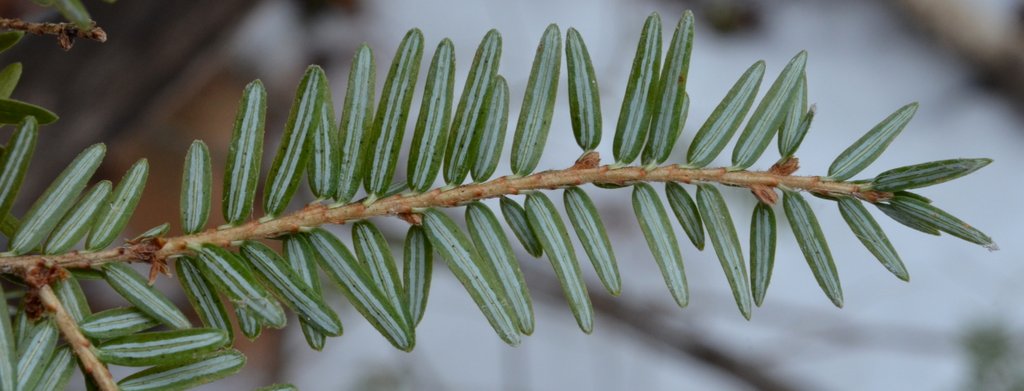
Hem of the Woods SW. Hem of the Woods is almost entirely hemlock in the overstory with very sparse cover in the understory. It is bordered to the NE by an artifical slope excavated out for the Island Line - now the bike path, the lake to the W, and a mature sugarbush along its southern border. Much of the diversity of plant life here is found at the borders or in breaks in the canopy.
 |
Stand of wild sarsaparilla in foreground, growing in shade of a couple recently
downed hemlocks (one massive). Birch is relic of older logging |
In one such sunny spot at the intersection of two trails where a few trees were cleared out (stumps remain as evidence), flowering plants thrive. In Hemlock Forests (yes capital H and F, see Wetland Woodland Wildland for the reference), flowering plants are incredibly uncommon. The anomalously high number of flowering plants in the understory can be attributed to the small size of the patch. In most cases, the understory vegetation is represented by small clumps of a single species, most of which can spread rhizomatically (e.g. posion ivy, rock polypody, false Solomon's seal, Canada mayflower). The seedlings are represented by an abundance of black cherry, a single basswood, occasional sugar maples, and several Norway maples, surprisingly. Shrubs were not abundant, and include glossy buckthorn, honeysuckle and red elderberry.
 |
| Doll's eyes flower stalk |
The two main limiting factor at this site are sunlight and shallow soils on calcareous bedrock. Lack of sunlight is controlled by the existing canopy in addition to a northern aspect. Where the deltaic sandy soils from the Champlain Sea era have eroded away with the occasionally flooding of the intermittent stream, Brick's Brook, the canopy is still composed of hemlock.
 |
| Red baneberry growing adjacent to doll's eyes. Note the much thinner stalks that the flowers grow from |
Below is a complete list of all the vascular plants I saw, except for the ferns (* = non-native).
Trees + Shrubs
| Hemlock, Eastern | Tsuga canadensis | | Pinaceae (Pine) |
| Maple, sugar | Acer saccharum | | Aceraceae (Maple) |
| Birch, white | Betula papyrifera | | Betulaceae (Birch) |
| Basswood, American | Tilia americana | | Malvaceae (Mallow) |
| Hophornbeam | Ostrya virginiana | | Betulaceae (Birch) |
| Buckthorn, common | Rhamnus cathartica | * | Rhamnaceae (Buckthorn) |
| Thimbleberry | Rubus odoratus | | Rosaceae (Rose) |
| Cherry, black | Prunus serotina | | Rosaceae (Rose) |
| Maple, Norway | Acer platanoides | * | Aceraceae (Maple) |
| Dogwood, alternate-leaf | Cornus alternifolia | | Cornaceae (Dogwood) |
| Ivy, poison | Toxicodendron radicans | | Anacardiaceae (Cashew) |
Flowers
| Mayflower, Canada | Maianthemum canadense | | Liliaceae (Lily) |
| Hepatica, round-leaf | Hepatica americana | | Ranunculaceae (Buttercup) |
| Jack-in-the-pulpit | Arisaema sp. | | Araceae (Arum) |
| Wild sarsaparilla | Aralia nudicalis | | Araliaceae (Ginseng) |
| Jewelweed, spotted | Impatiens capensis | | Balsaminaceae (Touch-me-not) |
| Solomon's seal, false | Smilacina racemosa | | Liliaceae (Lily) |
| Twisted stalk | Streptopus lanceolatus | | Liliaceae (Lily) |
| Stinking Benjamin | Trillium erectum | | Liliaceae (Lily) |
| Trillium, large-flowered | Trillium grandiflorum | | Liliaceae (Lily) |
| Bellwort, sessile-leaved | Uvularia sessilifolia | | Liliaceae (Lily) |
| Bellwort, large flowered | Uvularia grandiflora | | Liliaceae (Lily) |
| Crowfoot, small flower | Ranunculus abortivus | | Ranunculaceae (Buttercup) |
| Violet, downy yellow | Viola pubescens | | Violaceae (Violet) |
| Spikenard | Aralia racemosa | | Araliaceae (Ginseng) |
| Mystery mint | | | Lamiaceae (Mint) |
Ferns
| Fern, christmas | Polystichum acrostichoides | | Dryopteridaceae (Wood fern) |
| Oak-fern | Gymnocarpium dryopteris | | Dryopteridaceae (Wood fern) |
| Wood fern, intermediate | Dryopteris intermedia | | Dryopteridaceae (Wood fern) |
| Fern, sensitive | Onoclea sensibilis | | Onocleaceae (Sensitive Fern) |
| Polypody, rock | Polypodium virginianum | | Polypodiaceae (Polypody) |




.JPG)

.JPG)
