Showing posts with label rock point. Show all posts

Tuesday, August 9, 2016

A close call

Toads, for me, are like the perennial underdog, the bad news bears of the amphibian world. They're goofy and clumsy on land, often tumbling down rocks or embankments as they pronk around. Much of Burlington is on sandy deltaic sediments from the Champlain Sea. It drains well and there are scant wetlands, save along the Winooski River, flood zones along the lake, or retention ponds built to handle run off. I live near the latter most habitat and from my windows can hear toads trilling on the first warm (50+ degree) nights of spring. After 8 years of seeing toads in my garden and wishing they had a breeding habitat, I finally got around to building a pond. I got toad eggs and raised them to mature tadpoles before releasing them into the pond. After about 2 days of filling the pond with water we already had a couple of competing males trilling away.


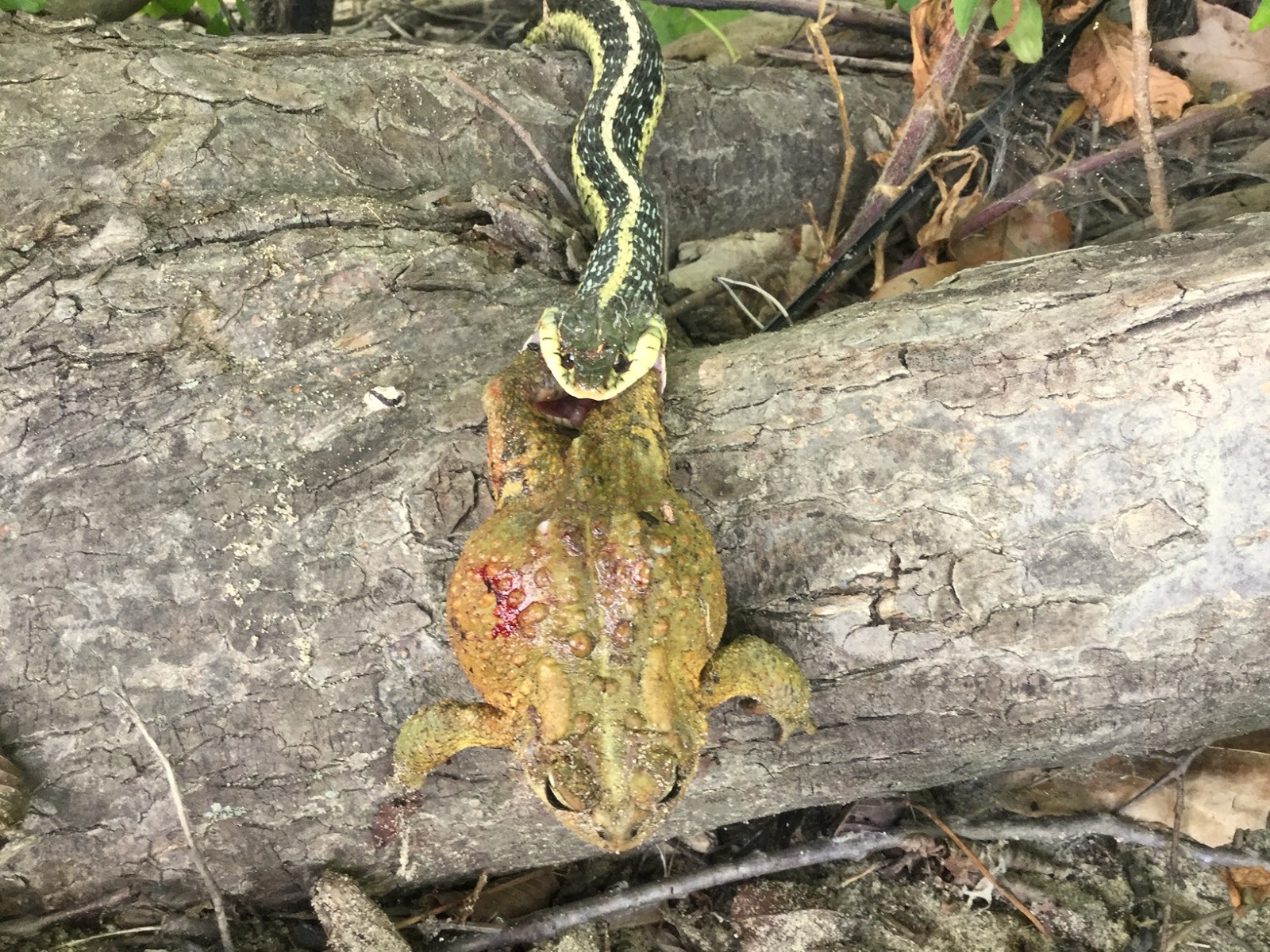
I've been seeing more and more toadlets (tiny, ~1/2") popping around, so looks like my first parenting project was a success! But not all is well in the land of toads. Today while out at Derf Beach (Fred's Beach to many, at the north end of North Beach), I was pulling poison ivy when all of a sudden I was spooked by a strange two-headed, two-legged beast. I yelled and jumped simultaneously. And then I realized what I was looking at!
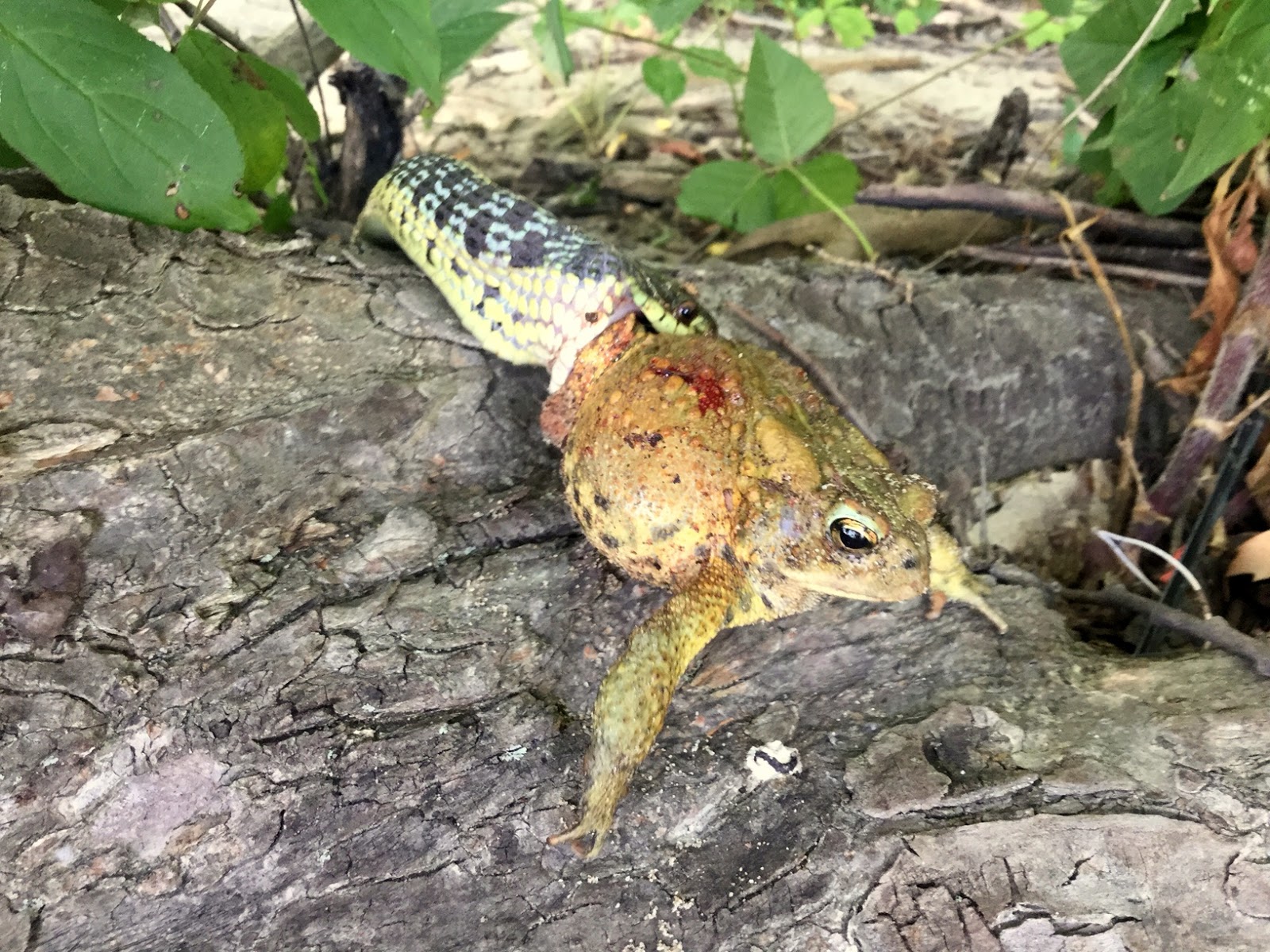
Oh, that leg. Not sure how the snake got both legs into its mouth. But it did. 

A yellow jacket showed up and curiously buzzed around the toad for a while

Eventually the snake wormed its way backward and over the green ash roots. Perhaps in response to us, trying to covet its meal. Each animal seemed to move in bursts followed by small movements trying to gain leverage. 


Oh, how my heart went out to that poor toad. And what a beast of a toad, easily one of the largest toads I've ever seen. We surmised that it was puffing out its chest to make it difficult for the garter snake to swallow it any further. We watched the struggle unfold for about 10 minutes before we had to leave. Perhaps the most striking realization that I had was that toads don't have facial expressions, a simple observation but so dramatic when I realized that this toad was having perhaps the most dramatic and terrifying experience of its life and it's face was totally stoic, or rather unchanged. As we were leaving someone called us back for the culmination of the struggle. The snake had decided it had bit off more than it could chew and released the toad from its grasp. A sad day for snake enthusiasts, a great day for toad-a-philes, and a fascinating, but morally neutral day for ecologists :)

Here's the toad post-battle.

Tuesday, August 2, 2016

The many moods of Lake Champlain

Just wanted to share a few images I've taken of Mink Bay at Rock Point over the past few weeks.

One of the more intense storms of the summer. Sudden gusts up to 40mph brought in sheets of rain for about 30 minutes. This was about 5 minutes before it hit

Calm and delightful sunset at Mink Bay

Paddling out past Lone Rock.

A fair weather cloud

Gap between Lone Rock and the Secret Cave

Friday, July 15, 2016

More blue green algae photos

Luckily a big afternoon storm rolled through on Wednesday afternoon, bringing with it intense winds and fresh rain. By Thursday much of the blue green algae had cleared out from what we at Crow's Path call Derf Beach (Fred's Beach to Rock Pointers) and most of the closed beaches were clear enough to swim in. I thought I'd post a few more photos, these from Wednesday before it cleared out.

The image below shows how a small sandbar created a windbreak, which created perfect conditions for the cyanobacteria to grow to high and potentially dangerous conditions. The waves seen just past the sand bar and already broken up much of the grosser pea soup swirls along North Beach before Wednesday's afternoon storm.


Tuesday, July 12, 2016

Blue-Green Algae

Feels like it's been forever since I posted here, and while I've been inspired to research many of the questions I've come across in recent months, this is the first time I've decided to follow up and write about it! So without further ado, blue green algae!


Today while out at Rock Point for Crow's Path summer camps, our efforts to find respite from the summer heat were thwarted by a nasty sludge lapping against the shoreline. When we got to the beach, life guards from North Beach were walking up and down the beach taking photos, likely as part of the state's blue green algae tracking efforts (see link for current reports from around the state). North Beach is a near perfect recipe for blue green algae blooms. It has a large shallow sandy beach that extends far out into the lake, with full exposure all day. It's also sheltered from winds out of the north, south, and west by Rock Point, winds that would otherwise bring in cooler water, which would slow down reproductive rates of the cyanobacteria, or disperse the blue green algae.

We've had air temperatures consistently above 70 since the middle of May. The water temperature is currently above 70(!!) and with the absence of wind, the conditions are perfect for blooms. The forecast is hot hot hot tomorrow with no wind. The rains could bring wind, which would shake things up, but they could also bring in more nutrients to the lake which would feed the cyanobacteria's growth.


How do you identify it?
  • It'll look like a greenish paste towards the surface, much like pea soup
  • When it gets super intense you'll see what looks like bluish or greenish swaths of paint on the surface
  • Before it gets to these concentrations, the water will take a greenish hint and you can see little green dots floating in the water. 

So if I see it in the water, what should I do?
  • Well, probably don't go in the water. According to the Vermont Dept of Health there are no known cases of the blooms causing human illness, but I'd rather not take the risk as associated symptoms may include:  
    • Skin rashes
    • Vomiting, diarrhea
    • Allergic-like reactions if water droplets inhaled
  • Don't let your pet go in the water. Pets won't know the difference and can drink the water and get ill
  • If you're on the fence about whether or not to go in the water, definitely check with whoever maintains the beach or check the state's blue green algae tracker

Taxonomy
Oh, and a note about taxonomy...or maybe a warning. Michigan botanists Edward Voss said, "Common names are for common people." Common names lead to lots of confusion about the organisms we're talking about. Blue green algae is a perfect example. While it is bluish green, it's not an algae. Algae alone is difficult enough. For a good exercise in frustration, try boning up on your algae taxonomy. Algae's not a plant (no roots, no leaves), but neighter is it a true bacteria (they're eukaryotes). Blue green algae is a bacteria, or more specifically cyanobacteria, a branch of photosynthetic bacteria. Being bacteria, they are simple organisms and super super tiny. We only get to see them when their populations get out of control.

Wednesday, May 27, 2015

Rock Point inventory: Brick's Brook


Next stop: Brick's Brook. Much of the sediment deposited atop the calcareous bedrock is lacustrine in origin (from a lake), deposited 11,000 years ago when the glaciers were retreating - melting - but still blocking drainage of the fresh water to the north through the St Lawrence seaway. Water pooled up in the Champlain Valley, the only outlet being the Hudson River valley to the south. The drainage point here is about 600', so Lake Champlain, which was known as Glacial Lake Vermont, was about 500' above where it is today.
The wet meadow, this is the "headwaters" of Brick's Brook

At the edge of the meadow, it starts to cut into the soils
About 25 down from previous photo, excessive erosion exposing roots of white pine
(which once upon a time was a fence line as witnessed by the barbed wire embedded in it)
The melt water draining off the mountains into the lake via the Winooski, Mississquoi, Lamoille, etc. would have been a muddy mess with glacial sediments. So Rock Point, which is adjacent to the lake, would have been a deep water environment, buried in alternating layers of silts and clays each year when the lake froze over. These silts and clays drain very poorly, accounting for  the wet meadows and depressions found scattered over the land.

Further still downstream. Slopes of banks still steep. 
Once the glaciers retreated far enough to the north, finally opening up the St Lawrence seaway, water exploded out of the Champlain Valley, draining in a matter of hours or days down to an elevation of 300'. At that point, because the glaciers were so heavy, their weight had actually depressed the entire northern part of the continent - much like a large putting all your passengers at the stern of a flexible boat - by about 300' in this area. The glacial lake gradually grew saltier and saltier as water from the ocean filtered into Champlain Valley. The rivers continued flowing into the body of water; the Winooski River delta's edge terminated at Rock Point, depositing patchy layers of sand atop the lacustrine silts and clays.

Soil map generated by Web Soil Survey: http://websoilsurvey.sc.egov.usda.gov/App/WebSoilSurvey.aspx
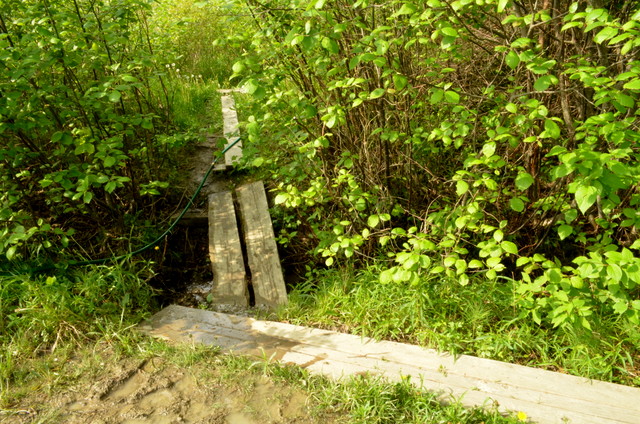
This sandier stuff erodes rather easily. Brick's Brook, which is only about 600m in length, starts as a trickle in the Old Pasture. A small bridge passes over the small notch carved into the clay soils. At the edge of the meadow, soils are much sandier and within 50m, the notch is a deep valley with steep slopes. Eventually the stream eroded down below the sandier soils, exposing silts and clays. Because these smaller soil particles are more difficult to erode, the valley widens rather than cutting further down. Towards the lower end of the stream the slope of stream is much gentler, water does not drain as well, and the course of the stream begins to meander, with water pooling up much more. In this section there are often green frogs and wood frogs.

Near the bottom, mellow grade to the brook and shallow slope to the banks due to erosion over time
High water table wreaking havoc on the hemlcoks and yellow birches
Species list is not complete (there are 5 different plants I need flowers to key out):

Maple, redAcer rubrumAceraceae (Maple)
Maple, sugarAcer saccharumAceraceae (Maple)
Ivy, poisonToxicodendron radicansAnacardiaceae (Cashew)
Birch, yellowBetula allegheniensisBetulaceae (Birch)
Viburnum, maple-leafViburnum acerifoliumCaprifoliaceae (Honeysuckle)
Honeysuckle, ??Lonicera ??*Caprifoliaceae (Honeysuckle)
Bittersweet, orientalCelastrus ????*Celastraceae (Bittersweet)
Dogwood, red-osierCornus sericeaCornaceae (Dogwood)
Witch-hazel, AmericanHamamelis virginianaHamamelidaceae (Witch-hazel)
Basswood, AmericanTilia americanaMalvaceae (Mallow)
Ash, greenFraxinus pennsylvanicaOleaceae (Olive)
Hemlock, EasternTsuga canadensisPinaceae (Pine)
Buckthorn, commonRhamnus cathartica*Rhamnaceae (Buckthorn)
Buckthorn, glossyFrangula alnifolia*Rhamnaceae (Buckthorn)
Blackberry, commonRubus allegheniensisRosaceae (Rose)
Cherry, blackPrunus serotinaRosaceae (Rose)
Raspberry, blackRubus occidentalisRosaceae (Rose)
Rose, multi-floraRosa multiflora*Rosaceae (Rose)
ThimbleberryRubus odoratusRosaceae (Rose)
Aspen, quakingPopulus tremuloidesSalicaceae (Willow)
GRAPE sp.Vitaceae (Grape)
Virginia creeperParthenocissus quinquefoliaVitaceae (Grape)
Jack-in-the-pulpitArisaema sp.Araceae (Arum)
Jewelweed, spottedImpatiens capensisBalsaminaceae (Touch-me-not)
Solomon's seal, falseSmilacina racemosaLiliaceae (Lily)
Crowfoot, small flowerRanunculus abortivusRanunculaceae (Buttercup)
Lily, troutErythronium americanumLiliaceae (Lily)
Skunk cabbageSymplocarpus foetidusAraceae (Arum)
DandelionTaraxacum officinalis*Asteraceae (Aster)
Meadow rue, earlyThalictrum dioicumRanunculaceae (Buttercup)
Baneberry, redActaea rubraRanunculaceae (Buttercup)
Nightshade, enchantersCircaea spOnagraceae (Evening primrose)
MiterwortMitella diphyllaSaxifragaceae (Saxifrage)
Nettle, woodLaportea canadensisUrticaceae (Nettles)
Nightshade, deadlySolanum dulcamara*Solanaceae
SpeedwellVeronica spScrophulariaceae (Figwort)
Fern, ladyAthyrium filix-feminaAthyriaceae
Fern, brackenPteridium aquilinumDennstaedtiaceae (Bracken)
Wood fern, spinuloseDryopteris carthusianaDryopteridaceae (Wood fern)
Wood fern, intermediateDryopteris intermediaDryopteridaceae (Wood fern)
Horsetail, woodEquisetum sylvaticumEquisetaceae (Horsetail)
Horsetail, meadowEquisetum pratenseEquisetaceae (Horsetail)
Fern, sensitiveOnoclea sensibilisOnocleaceae (Sensitive Fern)
Fern, ostrichMatteuccia struthiopterisOnocleaceae (Sensitive Fern)
Fern, cinnamonOsmunda cinnamomeaOsmundaceae (Royal fern)
Fern, interruptedOsmunda interruptaOsmundaceae (Royal fern)
Fern, maiden hairAdiantum pedatumPteridaceae (Maidenhair)
Fern, New YorkThelypteris noveboracensisThelypteridaceae (Marsh)

Monday, May 25, 2015

Rock Point Inventory - Hem of the Woods

Stand of hemlock, patches of moss indicating exposed bedrock (Dunham dolomite)
So it begins, my documenting of the plants of Rock Point, that is. Realizing I'd miss the early spring ephemerals, I thought I'd just start with the patches with lowest diversity and the ones that I'm most familiar with, before covering the rest of the property. I hope to finish these other patches by next summer. I spent a couple of hours this morning wandering around in my first area, which we call Hem of the Woods SW. Hem of the Woods is almost entirely hemlock in the overstory with very sparse cover in the understory. It is bordered to the NE by an artifical slope excavated out for the Island Line - now the bike path, the lake to the W, and a mature sugarbush along its southern border. Much of the diversity of plant life here is found at the borders or in breaks in the canopy.

Stand of wild sarsaparilla in foreground, growing in shade of a couple recently
downed hemlocks (one massive). Birch is relic of older logging
In one such sunny spot at the intersection of two trails where a few trees were cleared out (stumps remain as evidence), flowering plants thrive. In Hemlock Forests (yes capital H and F, see Wetland Woodland Wildland for the reference), flowering plants are incredibly uncommon. The anomalously high number of flowering plants in the understory can be attributed to the small size of the patch. In most cases, the understory vegetation is represented by small clumps of a single species, most of which can spread rhizomatically (e.g. posion ivy, rock polypody, false Solomon's seal, Canada mayflower). The seedlings are represented by an abundance of black cherry, a single basswood, occasional sugar maples, and several Norway maples, surprisingly. Shrubs were not abundant, and include glossy buckthorn, honeysuckle and red elderberry.

Doll's eyes flower stalk
The two main limiting factor at this site are sunlight and shallow soils on calcareous bedrock. Lack of sunlight is controlled by the existing canopy in addition to a northern aspect. Where the deltaic sandy soils from the Champlain Sea era have eroded away with the occasionally flooding of the intermittent stream, Brick's Brook, the canopy is still composed of hemlock.

Red baneberry growing adjacent to doll's eyes. Note the much thinner stalks that the flowers grow from
Below is a complete list of all the vascular plants I saw, except for the ferns (* = non-native).

Trees + Shrubs
Hemlock, EasternTsuga canadensisPinaceae (Pine)
Maple, sugarAcer saccharumAceraceae (Maple)
Birch, whiteBetula papyriferaBetulaceae (Birch)
Basswood, AmericanTilia americanaMalvaceae (Mallow)
HophornbeamOstrya virginianaBetulaceae (Birch)
Buckthorn, commonRhamnus cathartica*Rhamnaceae (Buckthorn)
ThimbleberryRubus odoratusRosaceae (Rose)
Cherry, blackPrunus serotinaRosaceae (Rose)
Maple, NorwayAcer platanoides*Aceraceae (Maple)
Dogwood, alternate-leafCornus alternifoliaCornaceae (Dogwood)
Ivy, poisonToxicodendron radicansAnacardiaceae (Cashew)

Flowers
Mayflower, CanadaMaianthemum canadenseLiliaceae (Lily)
Hepatica, round-leafHepatica americanaRanunculaceae (Buttercup)
Jack-in-the-pulpitArisaema sp.Araceae (Arum)
Wild sarsaparillaAralia nudicalisAraliaceae (Ginseng)
Jewelweed, spottedImpatiens capensisBalsaminaceae (Touch-me-not)
Solomon's seal, falseSmilacina racemosaLiliaceae (Lily)
Twisted stalkStreptopus lanceolatusLiliaceae (Lily)
Stinking BenjaminTrillium erectumLiliaceae (Lily)
Trillium, large-floweredTrillium grandiflorumLiliaceae (Lily)
Bellwort, sessile-leavedUvularia sessilifoliaLiliaceae (Lily)
Bellwort, large floweredUvularia grandifloraLiliaceae (Lily)
Crowfoot, small flowerRanunculus abortivusRanunculaceae (Buttercup)
Violet, downy yellowViola pubescensViolaceae (Violet)
SpikenardAralia racemosaAraliaceae (Ginseng)
Mystery mintLamiaceae (Mint)
Ferns
Fern, christmasPolystichum acrostichoidesDryopteridaceae (Wood fern)
Oak-fernGymnocarpium dryopterisDryopteridaceae (Wood fern)
Wood fern, intermediateDryopteris intermediaDryopteridaceae (Wood fern)
Fern, sensitiveOnoclea sensibilisOnocleaceae (Sensitive Fern)
Polypody, rockPolypodium virginianumPolypodiaceae (Polypody)